
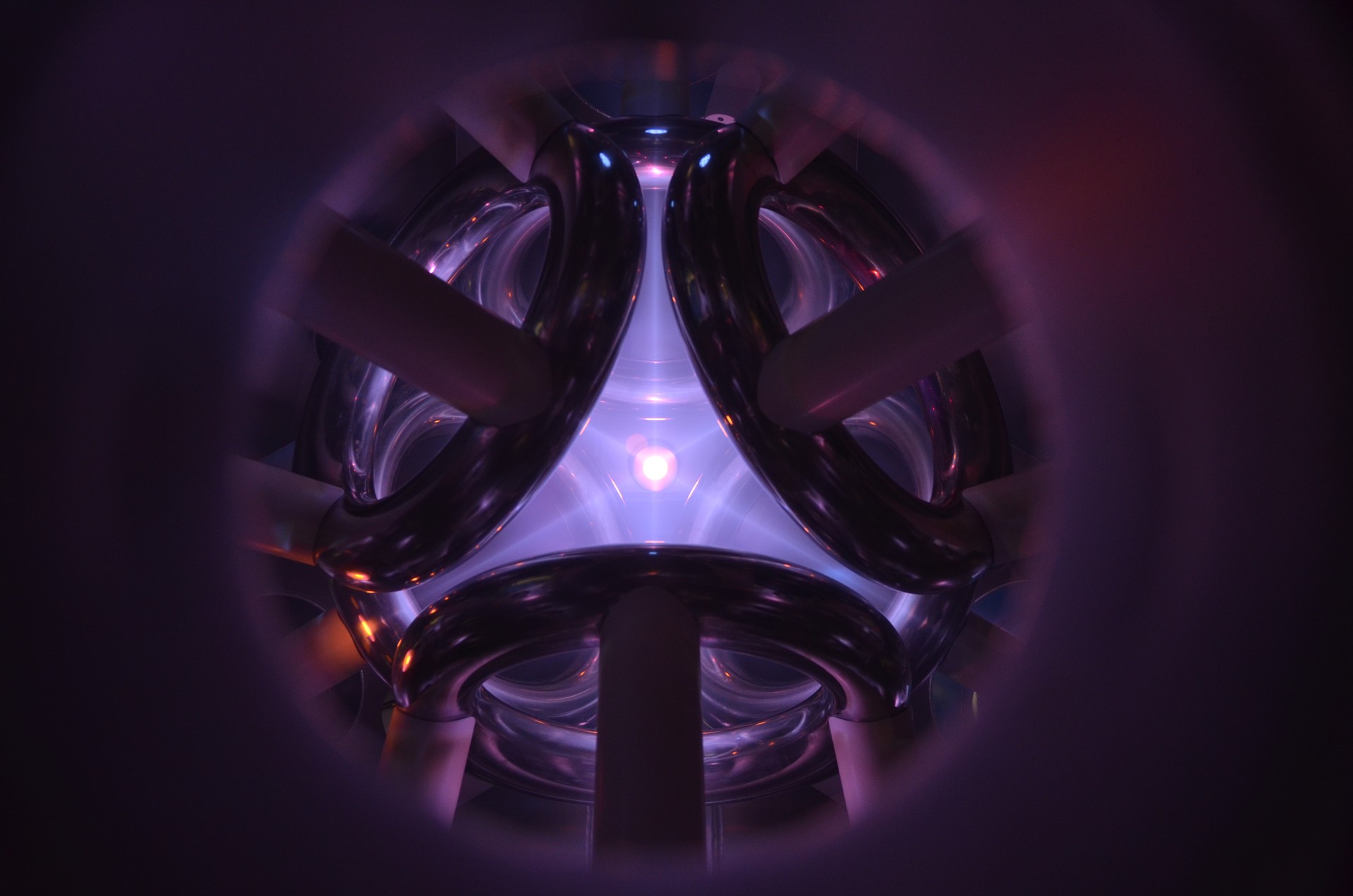
 A cusp-confined plasma during the initial low-density start-up phase inside the WB-8 experimental device.
We sat down with Dr. Jaeyoung Park, the CEO of EMC2 (Energy Matter Conversion Corporation), to discuss the company's current work and its long-term vision for accelerating fusion development.
Founded in 1985 by the late Dr. Robert Bussard, EMC2 is the developer of the Polywell, a fusion concept that combines magnetic cusp confinement of electrons with electrostatic confinement of ions. Over four decades and 20 test devices, much of that work supported by the US Navy, the company has built an experimental record it has recently synthesized into a first-principles simulation framework, published in the paper Polywell Revisited. EMC2 is now preparing WB-11, a 1-meter-scale device designed to validate those predictions. In parallel, the company is developing a Polywell-based volumetric neutron source as a near-term commercial application aimed at the materials testing and tritium breeding bottlenecks facing the broader fusion industry.
EMC2 has been pursuing Polywell fusion since 1985, making it the oldest private fusion company in the world. How did the company get started, and what has kept it going through four decades of fusion research?
The Origins and the Engineering Vision. EMC2 was founded in 1985 by the late Dr. Robert Bussard, who had a brilliant vision: combining two very distinct fusion approaches: the high-beta magnetic cusp and inertial electrostatic confinement (IEC). He called this hybrid approach the Polywell, a name reflecting its two foundational physics concepts.
Dr. Bussard was drawn to the Polywell because it offered what is arguably the most attractive engineering pathway to practical fusion power, and he was convinced he had glimpsed the physics required to make this combination work. During dinners I shared with him in 2006, just a year before his passing, he spoke deeply about his sense of duty to ensure fusion energy ultimately benefited society. It was a theme that resonated strongly with me, given our shared history of working at Los Alamos National Laboratory for extended periods.
The Pact That Kept Us Going. As for what has kept EMC2 going through four decades of ups and downs, it comes down to a single premise. The late Dr. Bussard, Dr. Nicholas Krall, Mr. Mike Skillicorn, and Prof. Giovanni Lapenta all made tremendous scientific contributions to the Polywell. Together, we shared a pact: we would gladly pivot our devotion to other worthy physics challenges if we ever found a critical, insurmountable flaw in the Polywell approach.
Time and again, we faced difficult physics and engineering challenges, but we have found pathways to overcome them with the past support from the US Navy and private investors. So, that day simply never came. Until it does, I am deeply honored to remain bound to that pact.
The Beauty of Science. Beyond that sense of duty, there is the sheer beauty of the science itself that keeps us driven. Today, utilizing modern high-performance computing tools to visualize the Polywell's intricate 3D properties, I can see that it exhibits some of the most beautiful plasma dynamics in nature. Polywell shares its magnetic field topology structure with Earth's magnetosphere, a long-recognized feature in magnetic cusp physics. It is Earth's magnetic geometry, not its raw field strength nor brute force, that stably shields us from the mighty solar wind from the Sun's fusion core over billions of years.
The broader fusion industry has exploded in recent years with new companies, new capital, and serious commercial momentum. What does that shift mean for a company like EMC2 that has been working on this for 40 years?
The recent explosion in private fusion is incredibly validating. In 1985, a private fusion company was an oxymoron; today, billions in venture capital prove the world finally sees fusion as a commercial engineering reality. For a pioneer like EMC2, this momentum changes everything in two key ways:
The Value of Data and Patient Innovation. The massive amount of new experimental data generated by these recent investments is deeply encouraging. At EMC2, we intimately understand the value of this kind of data—we have built 20 Polywell test devices over the years to incrementally build our understanding. For us, a critical breakthrough occurred over the past decade when we were able to extract that hard-won knowledge and synthesize it into a rigorous scientific foundation using modern high-performance computing. That process takes time, dedicated effort, and the occasional "a-ha" moment. When dealing with fusion plasma, time and patience are often the true prerequisites for a breakthrough.
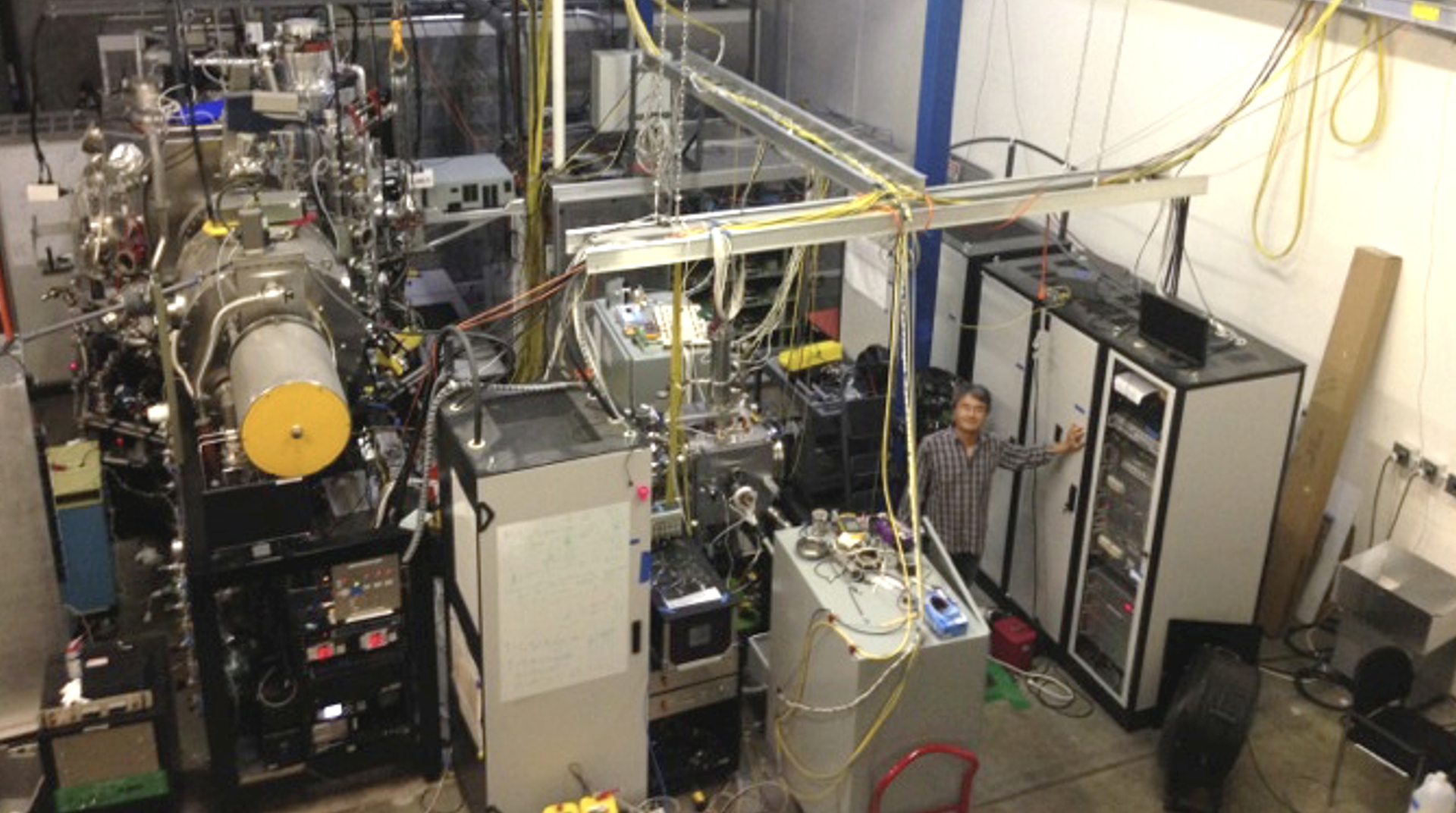 Dr. Jaeyoung Park with two generations of Polywell devices, WB-8 (left) and its high-beta successor WB-X (center) devices at EMC2's facility. The extensive experimental data generated by these legacy machines provided the foundational physics basis for the company's recent breakthroughs in 6D first-principles simulations.
The Shift to Practical Energy Generation. The industry has moved past the era of pure scientific demonstration. The goal has shifted entirely toward practical, grid-scale energy generation, which aligns perfectly with EMC2's focus on the inherent engineering simplicity of the Polywell. The broader industry is currently building the road and the supply chain humanity needs. We are encouraged by this progress and plan to incorporate the technological advances from others. On the other hand, we remain convinced that the Polywell’s engineering simplicity positions it as one of the most promising scalable paths to building many hundreds of fusion power plants once our core physics milestones are completed.
Polywell takes a different approach to fusion than tokamaks and stellarators. For a non-specialist audience, what is the core idea, and why do you believe it offers a viable path to commercial fusion energy?
Conventional fusion devices like tokamaks often struggle to keep plasma stable. Polywell takes a completely different path by using a magnetic shape called a cusp, widely regarded as one of the most inherently stable magnetic configurations, though historically plagued by poor plasma confinement. We have spent years working on this by developing a scalable way to combine that magnetic cusp with electric fields at the confinement boundary. This was Dr. Bussard's core idea for the Polywell, drawing inspiration from the Hirsch-Farnsworth fusor to essentially plug those leaks at the plasma edge.
This breakthrough translates into a massive commercial advantage. Because our configuration is intrinsically stable, a Polywell device can operate at a plasma density about 100 times higher than conventional tokamaks, and well above even the newest high-field designs based on High-Temperature Superconductors (HTS). In fusion, power output increases with the square of the plasma density. This means a 10-fold increase in density yields 100 times the fusion power. So we can generate 100 MW to 1 GW of fusion energy from a much smaller, mechanically simpler Polywell machine, offering a highly economical path to commercial grid power.
EMC2 recently published a paper reassessing the Polywell concept and laying out an updated path to net energy. What was the significance of that work, and what does it say about where EMC2 stands today?
The paper, Polywell Revisited, is the culmination of ten years of effort to update our scientific foundation using first-principles 6D plasma simulations grounded in past experimental data. It is the most rigorous synthesis of our physics models to date, upon which WB-11 experimental validation will be built. It is also the final chapter to a series of four experimental and computational papers we published over that period. For anyone diving into the research, I recommend starting with Polywell Revisited and reading backward in time.
For EMC2, the significance of this work is twofold. First, it gives us a powerful, predictive tool to guide the engineering of a commercial Polywell device. Second, it provides a detailed blueprint for a net-power-producing machine. If these computational results are experimentally validated in our upcoming WB-11 test device, we will have a clear, actionable path to commercial fusion energy.
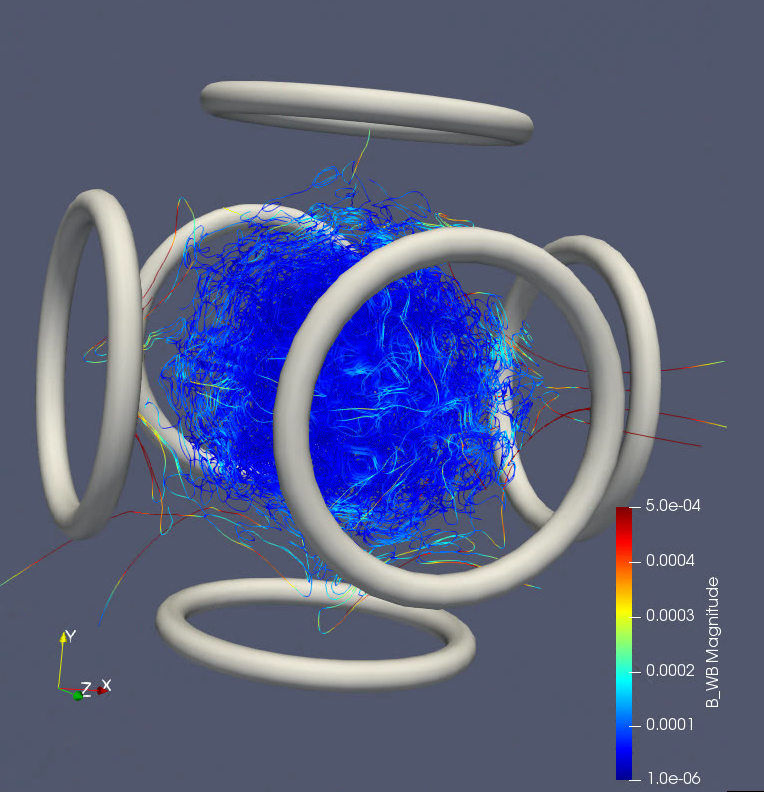 The internal magnetic field structure of a fully formed high-beta state inside the Polywell device, visualized via the 6D first-principles simulations featured in the recent "Polywell Revisited" paper to predict the plasma confinement conditions before they are tested in hardware. The WB-11 experimental program is designed to validate these predictions.
EMC2 is now developing its next experimental device, WB-11. What are you trying to demonstrate with it, and what does success look like?
With WB-11, which will be a 1-meter scale device operating at roughly a 1-Tesla magnetic field, success comes down to three primary goals over the next three years.
First, we need to demonstrate the sustainment of high-beta plasma inside the Polywell. This will extend the groundbreaking experimental work we did on WB-X, but just as importantly, it strengthens the physics basis for Polywell neutron sources. We are designing these variants specifically to support the tritium breeding blanket and close the fusion fuel cycle, as well as fusion materials testing, which are critical needs for the broader fusion ecosystem.
Second, we aim to prove we can actively control the electric field at the plasma boundary using electron beam injection. This validates Dr. Bussard’s original vision: combining the intrinsic economic benefits of the cusp configuration with ingenious confinement control. There is actually a great historical parallel here for the fusion community. The advance that essentially saved the global tokamak program in the 1980s was the discovery of the H-mode by the ASDEX team in Germany, a breakthrough that is today attributed to boundary layer electric fields. We are applying the same boundary-control principle, but to the cusp geometry, to maximize economic returns.
Finally, we need quantitative validation of our 6D first-principles simulations, especially regarding the boundary layer electric field control and microinstabilities that could degrade plasma confinement. As I mentioned earlier, once we demonstrate in physical hardware that our predictive computational tools are accurate and reliable, we will have a clear, de-risked blueprint for commercializing Polywell fusion devices.
Beyond the fusion energy goal, EMC2 is pursuing a fusion prototypic neutron source/ Volumetric Neutron Source (FPNS / VNS) as a near-term application. What is that opportunity, how does it address the materials testing bottleneck, and how does it fit into the broader supply chain commercial fusion will need?
The opportunity here addresses what are arguably the most urgent bottlenecks in the entire fusion ecosystem right now. As the broader industry races toward building commercial power plants, there is a growing realization that you cannot just build a working fusion device. You must concurrently develop and test the materials that will survive inside a fusion power plant, and you must close the fusion fuel cycle by mastering the tritium breeding blanket. Currently, the lack of a dedicated, high-flux FPNS/VNS is a critical supply chain gap that threatens to stall the entire industry's commercial timelines.
This near-term application is a perfect fit for where EMC2 stands today because we do not need to achieve net fusion energy to build it. Because the Polywell’s high-beta cusp allows us to produce a very high-density target plasma that can be irradiated by a technologically mature steady-state ion beam, we can deliver the high-flux neutron environment the industry requires for both materials testing and tritium breeding development. Crucially, we can do this in compact, mechanically simple, and cost-effective packages.
In fact, EMC2 recently submitted a conceptual design study proposal for an Ion Beam-Driven Polywell Volumetric Neutron Source (VNS) to the U.S. Department of Energy, partnering with six industry and national laboratory collaborators. It is designed to deliver a yield of about D-T fusion neutrons per second and a flux of about neutrons per second per square centimeter on the six independent test volumes, each with the surface areas of up to 85 cm by 85 cm. For EMC2, developing this neutron source isn't a distraction from our ultimate goal of grid power. It is a critical stepping stone that allows us to generate near-term commercial value. By keeping the capital cost of the whole facility in the targeted range of $500M, we will be directly filling the most pressing supply chain chasm for the entire fusion community.
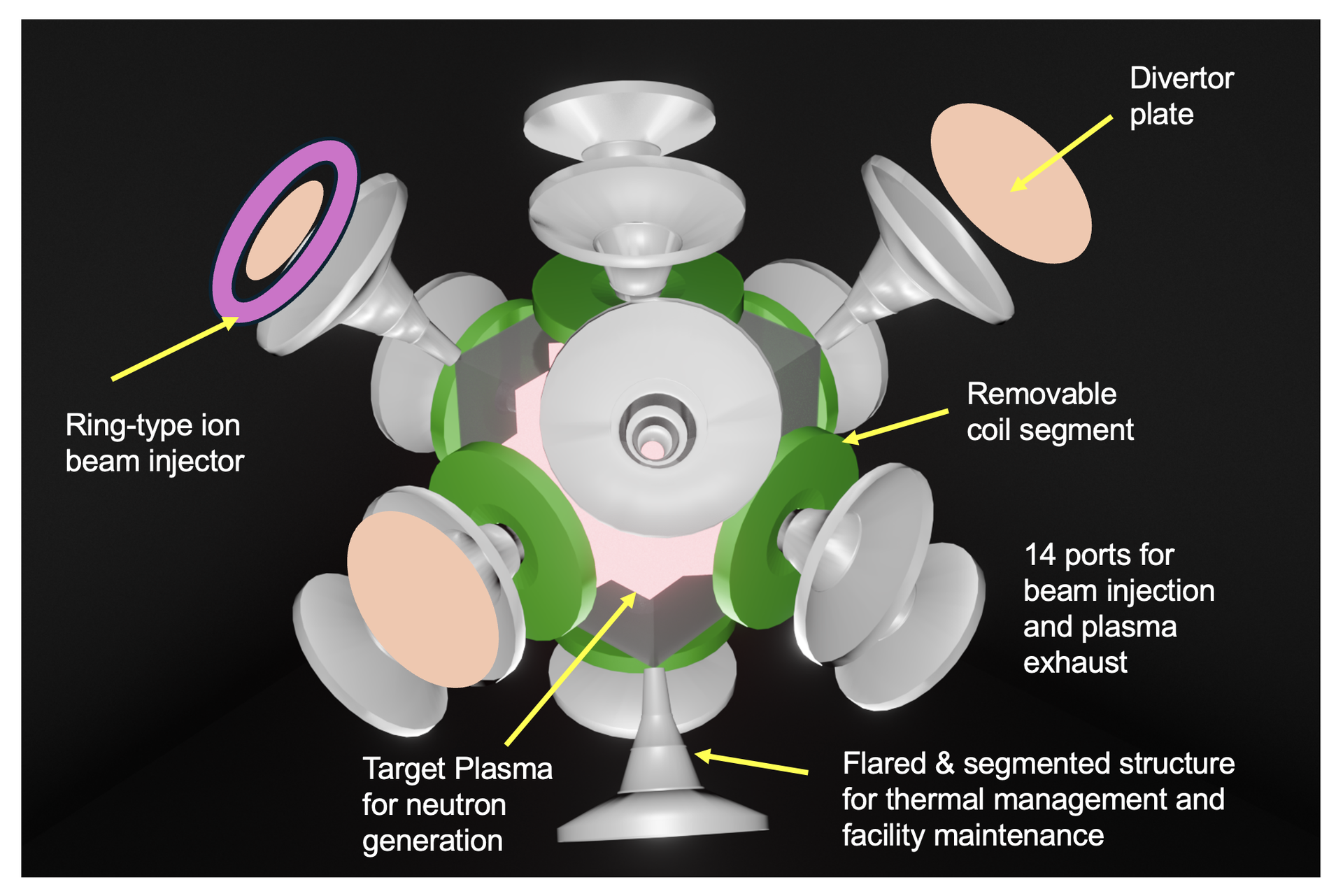 Conceptual design rendering of EMC2's proposed Volumetric Neutron Source (VNS), a near-term application of Polywell technology, recently proposed to the Department of Energy as a near-term commercial solution to the industry's tritium breeding development bottleneck.
What does the next decade look like for EMC2, and what would you want the fusion industry to understand about where the company is headed?
The next decade for EMC2 comes down to three clear objectives:
First, we are here right now to help the industry solve its neutron source bottleneck. So, stay tuned.
Second, we are actively developing a Polywell fusion energy device designed to upend the fusion economics curve. So, stay vigilant.
Finally, we will collaborate with others to lead what we consider the most important step in fusion development: developing and verifying a first-principles, predictive computational tool. The goal is no longer about brute-forcing a bigger machine; it is about outsmarting the plasma to make fusion energy truly economically feasible. So, let’s work together.
Bonus: Why is now a particularly exciting time for students to get involved in fusion energy, and what opportunities do you see for the next generation entering the field?
With the world urgently demanding sustainable energy solutions, I believe the timing is perfect for students. We finally have the computational means to untangle the complex plasma dynamics inside these devices. This is what will allow us to design economically feasible fusion reactors and start building them en masse, considering that it will take many hundreds of 1-GW fusion power plants just to address 10% of the world's electricity needs.
So, if students are up for the challenge, this is the time to make a difference. The industry needs brilliant minds in plasma physics and high-performance computing, but also in engineering—spanning materials, power electronics, nuclear, civil, and plant engineering. They have the opportunity to reshape our future, fulfilling a goal that Dr. Bussard and I shared during our dinners years ago: ensuring that fusion energy ultimately benefits society.

