
Projects
Add and manage your project page
FM-1
Princeton Plasma Physics Laboratory
1971 - 1976
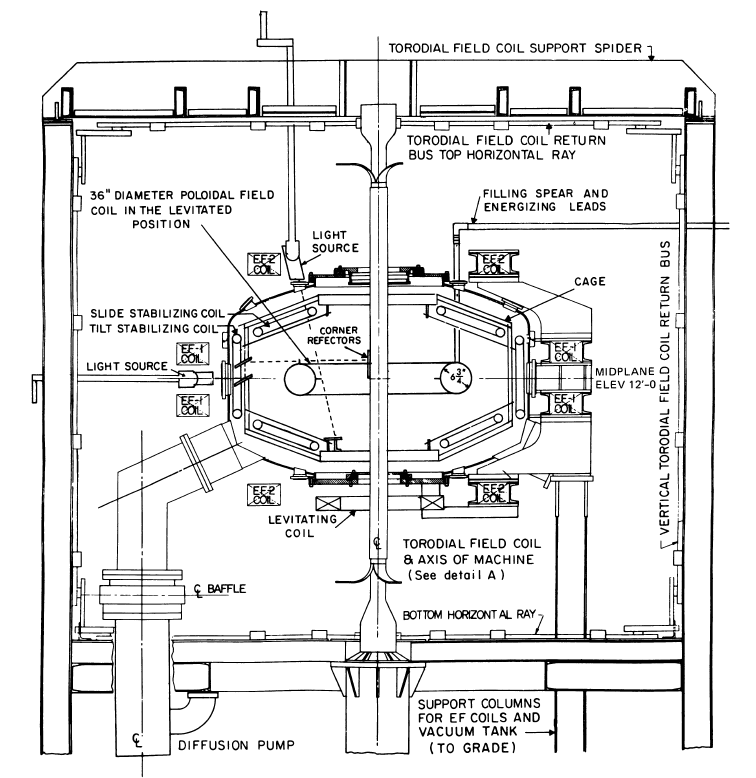
The Floating Multipole Machine (FM-1) was a spherator built and designed at PPPL. It was a bigger version of the LSP device. This device had an internal superconductive ring of 0.75 m major radius with a current capability of 350 kA. This ring levitated due to its own magnetic field interacting with 5 sets of stabilization coils and was able to remain afloat for an 8 hour experimental shift in a room temperature environment. FM-1 reached electron temperatures around 100 eV and ion temperatures below 5 eV . Its typical magnetic field was around 0.3 T and reached a confinement time up to 3 seconds. FM-1 is considered one of the earliest poloidal divertor experiments.
LSP
Princeton Plasma Physics Laboratory
1970 - 1971
The Levitated Spherator (LSP) was the first spherator built with a levitated internal ring at PPPL. LSP was similar to SP-3 in geometry but without the internal ring supports. The idea of levitating the ring instead of using mechanical supports was to increase the confinement time by eliminating the particle losses due to asymmetries caused by the supports in previous spherators.
It had a superconductive internal ring with a radius of 0,46 m and capable of transporting a 85 kA current, that was levitated with magnetic fields. To keep the superconductivity, the ring was filled with liquid helium to keep it cold. It used ECRH heating with 10ms pulses of 1kW 2.45 GHz microwaves and steady heating of 60 W 3.5 GHz microwaves, which produced temperatures up to 10 eV. LSP was also heated ohmically, reaching temperatures up to 100 eV. This device had an average magnetic field of 0.1 T. FM-1 was a larger version of this device.
SP-1
Princeton Plasma Physics Laboratory
1968 - 1969
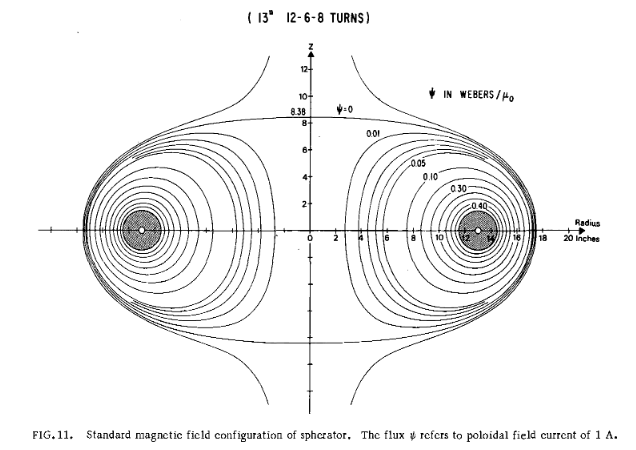
Supported Spherator 1 (SP-1, sometimes called just Spherator) was a device built at PPPL. SP-1 had a 0.75 m diameter stainless steel vacuum vessel. It had a 0.325 m radius internal ring that was mechanically supported by six supports with 1/8" stainless rods (around 3 mm diameter) and was water cooled. This ring had a 72 kA current and produced a magnetic field of 0.1T.
The objectives of the experiment were to determine how the plasma is lost, to deterimine whether the plasma is unstable, and to study the production and the generation of plasmas in the spherator geometry.
SP-1 was later modified to reduce the feedthrough from 3 cm to 4 mm diameter by eliminating the water cooling system. The supports were also substituted with smaller rods (1 mm diameter). These modifications allowed the average flight distance of the particles (the distance before hitting a support or the feedthrough) to be increased from 10m to 50m.
SP-3
Princeton Plasma Physics Laboratory
1969 - 1969
Supported Spherator 3 (SP-3) was a spherator built at PPPL. It had a mechanically supported 0.46 m radius superconductive internal ring. The ring was supported with three 4mm upper supports and three 1mm lower supports.

