
Model C
Last updated
Associated Organization:
Publications
Plasma Physics, 2002
Nuclear Fusion, 1985
Years Operated
1962 - 1969
Model C was a stellarator built and operated at the Princeton Plasma Physics Laboratory (PPPL). The device's design and implementation planning began in 1954 and started operations in March 1962.
Model C was the biggest of a series of stellarators that marked the beginning of fusion research at Princeton. It had a racetrack-like geometry with two semicircular sections with helical windings connected with two straight segments, one that contained a divertor and the other contained 4 MW of ion cyclotron resonance heating. Even though Model C represented a major upgrade in comparison with models A and B, it did not achieve the expected temperature and confinement results for which it was designed.
Finally, in 1969, Model C stopped operations and was converted into a tokamak geometry, changing its name to Symmetric Tokamak (ST).
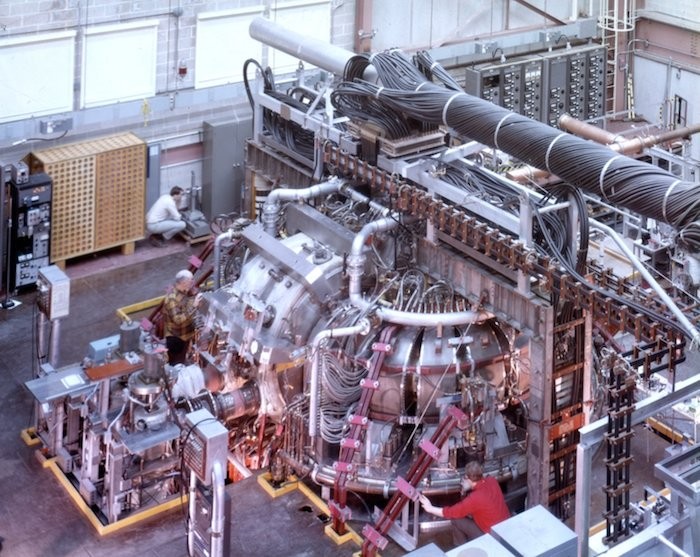
Attribution: https://w3.pppl.gov/~hammett/refs/2013/Spitzer_100th_Hammett_2013.pdf
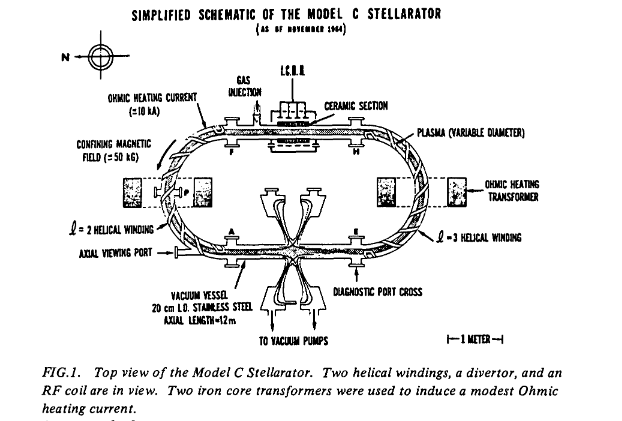
Attribution: https://iopscience.iop.org/article/10.1088/0029-5515/25/9/047/pdf

