
Projects
Add and manage your project page
CSX
Columbia Fusion Research Center
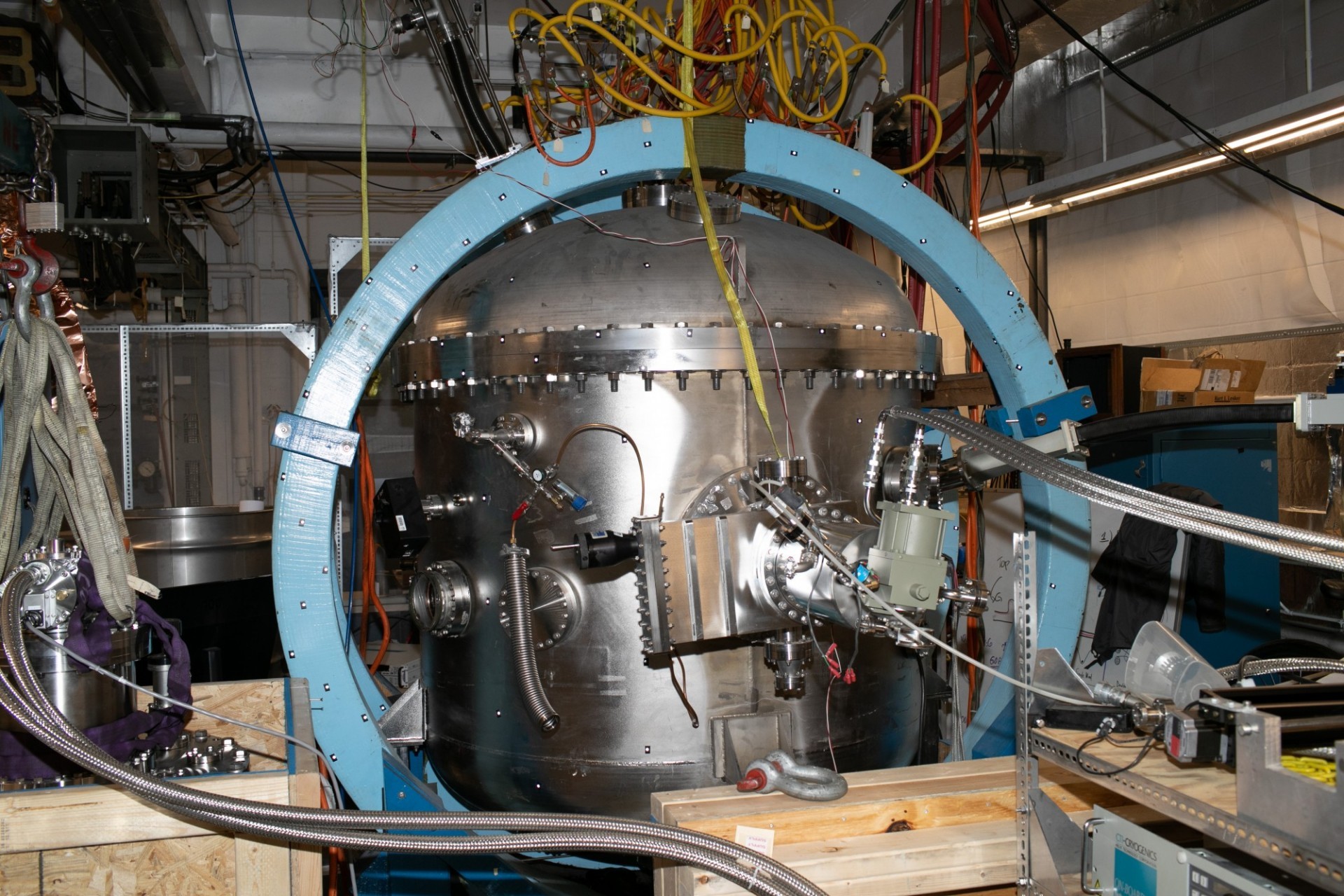
The Columbia Stellarator eXperiment (CSX) is a superconducting, quasi-symmetric stellarator. It is being built to test novel stellarator geometries and their intersection with high-temperature superconducting magnet technologies. It is being repurposed from the Columbia Non-neutral Torus (CNT).
Eos
Thea Energy
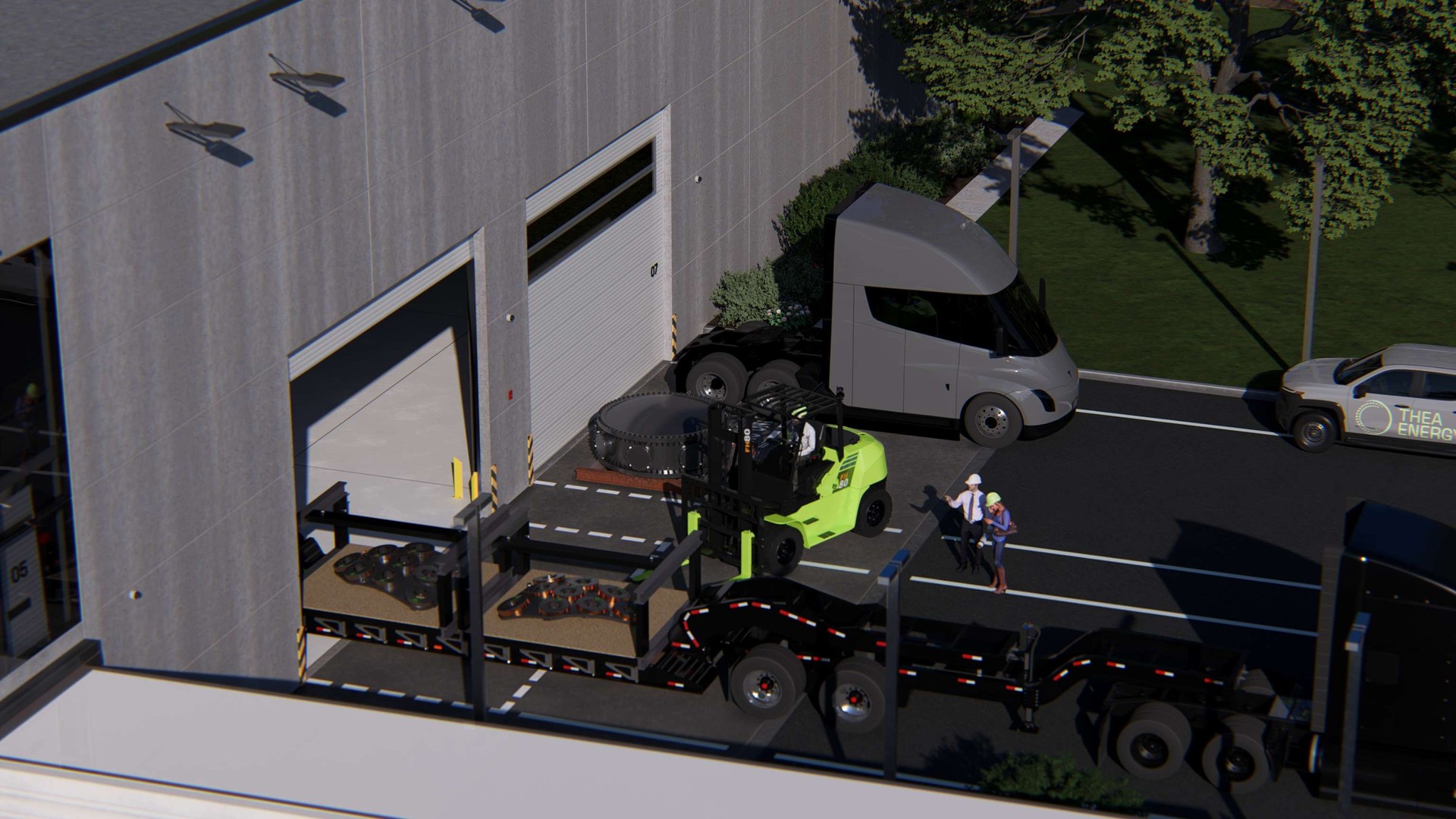
Thea Energy's "Eos" large-scale integrated stellarator facility will create steady-state fusion using the Company’s simplified planar coil magnet architecture. Eos leverages arrays of mass-manufacturable, superconducting magnet hardware and software-based control systems. Eos derisks Thea Energy’s first commercial fusion power plant, "Helios", and is anticipated to begin operations in 2030.
ETUDE
Princeton Plasma Physics Laboratory
1957 - 1961
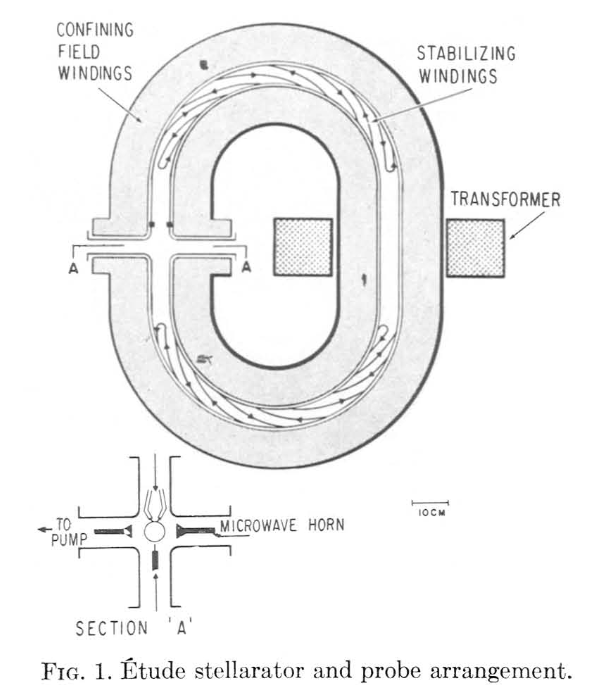
The Étude stellarator was a device built and operated at Princeton University as part of Project Matterhorn (today PPPL). It was originally named A-2 but was renamed as Étude which is the french word for "study". It was a steady-state device with a racetrack geometry used mainly for the study of collective plasma behavior, drift waves, and ohmic heating. Étude had water cooled helical windings that produced a rotational transform and magnetic shear. It was built with 5 cm diameter stainless steel tubes and confining magnetic field of 0.67 T.
Helios
Thea Energy
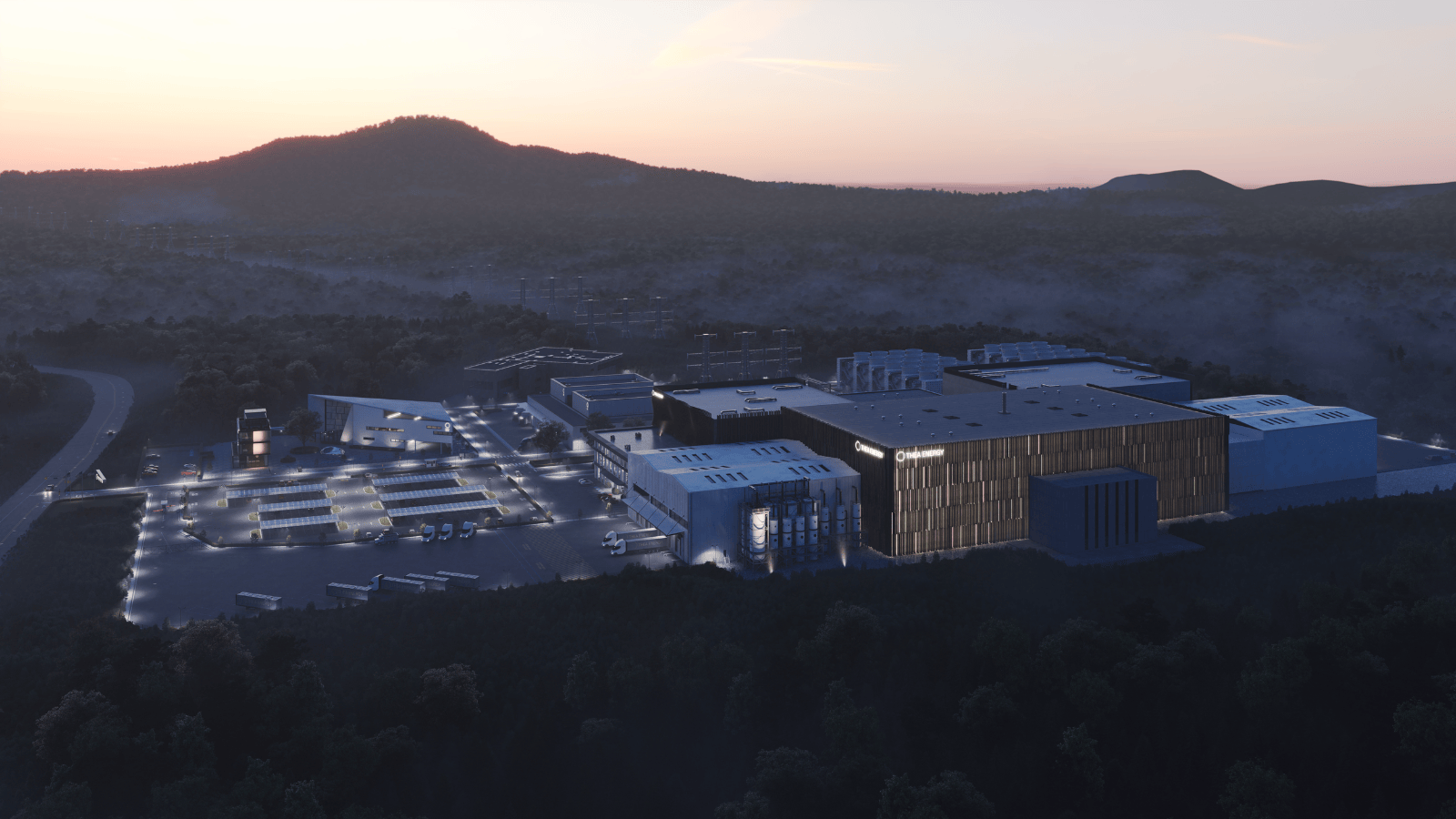
Thea Energy's "Helios" is a 400 MW fusion power plant that leverages the Company's proprietary planar coil stellarator architecture and will provide abundant fusion energy to the electrical grid. Helios combines the inherent benefits of the stellarator, including steady-state operation and high efficiency, with a practical maintenance scheme enabled by the simple, programmable magnet hardware.Thea Energy plans to operate Helios in the 2030s.
Heliotron J
Kyoto University
Helix HARUKA
Helical Fusion
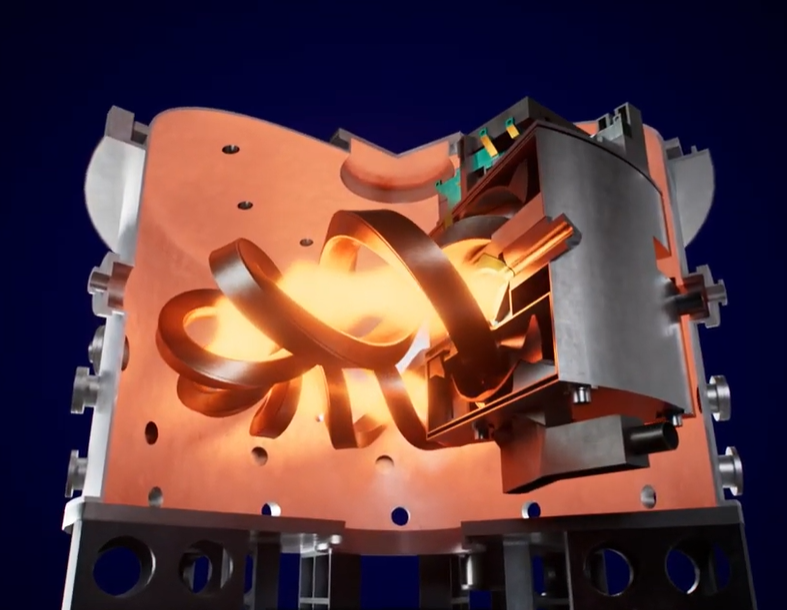
Helix HARUKA is a high-magnetic-field helical stellarator being developed by Helical Fusion in Japan. It will deploy high-temperature superconductor (HTS) magnets together with a liquid-metal (LM) wall/blanket system in a power-plant-relevant configuration. The primary KPIs for HARUKA are successful system integration of the HTS magnet system and LM blankets into a single fusion machine, and demonstration of long-duration, steady-state plasma operation targeting continuous runs of more than 24 hours. Helix HARUKA is not designed to generate electricity; instead, it will serve as the integrated physics-and-engineering testbed that de-risks and validates the core technologies required for the Helix KANATA power plant.
Helical Fusion has been constructing Helix HARUKA with the aim of operating it around 2030 as a key milestone on its roadmap toward commercial stellarator fusion.
Helix KANATA
Helical Fusion
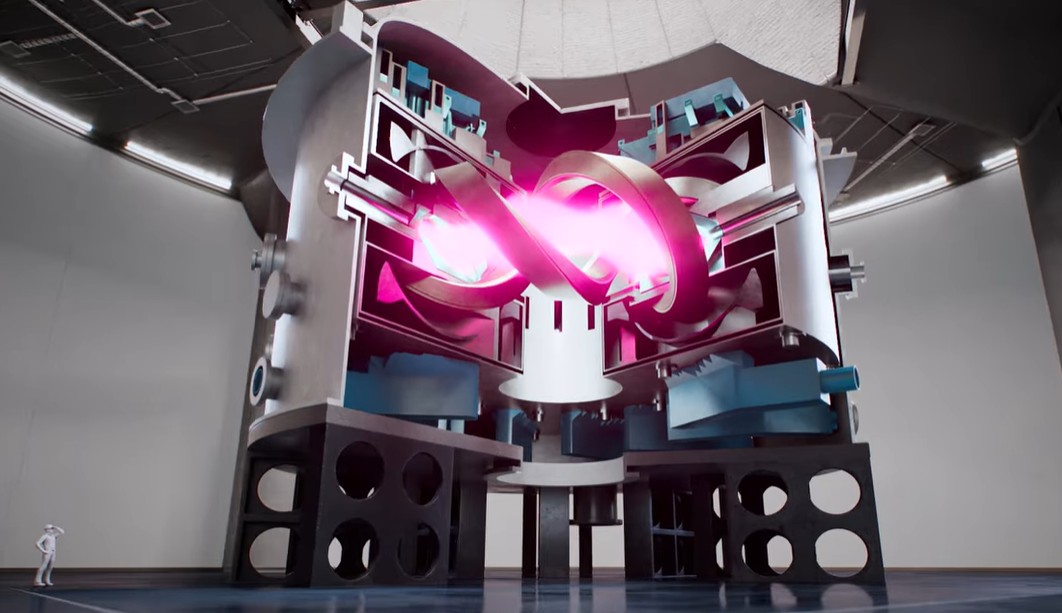
Helix KANATA is a next-generation helical stellarator fusion pilot plant concept that builds directly on the technologies demonstrated in Helix HARUKA. KANATA is designed as a fully integrated fusion power plant, combining HTS stellarator magnets, a liquid-metal breeding blanket, tritium fuel-cycle systems, heat-extraction loops, and turbine-based balance-of-plant to generate net electricity on a continuous, steady-state basis. The goal of the Helix KANATA device is to serve as a commercial-scale, zero-carbon fusion power plant capable of supplying reliable baseload electricity and high-grade heat for industrial users.
Helical Fusion currently aims to bring the first Helix KANATA plant into operation in the 2030s, following successful achievement of the key performance targets on Helix HARUKA.
HIDRA
University of Illinois Urbana-Champaign
2014 - Present
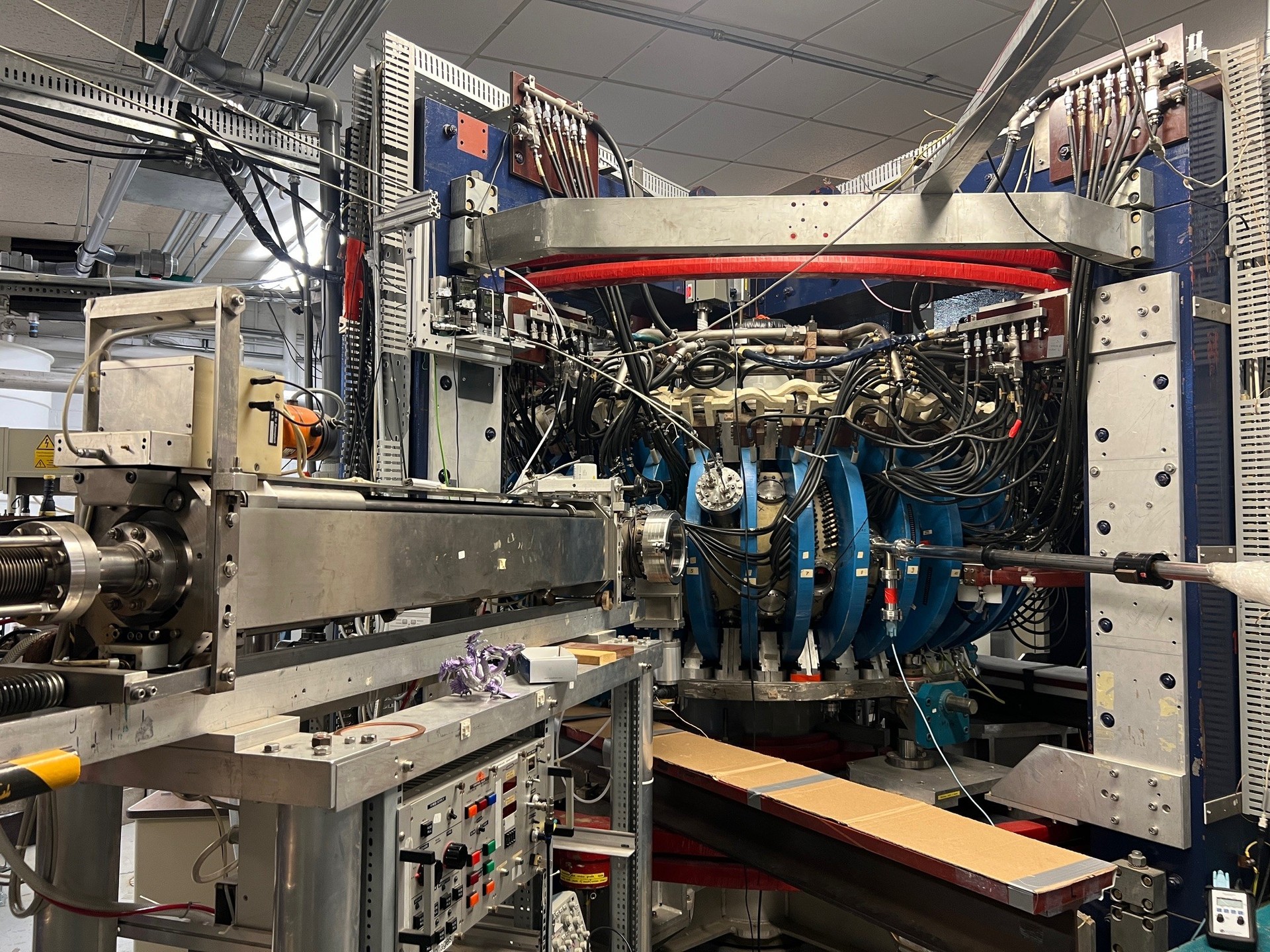
The Hybrid Illinois Device for Research and Applications (HIDRA) is a 5-period, l = 2, m = 5, classical stellarator at the University of Illinois Urbana-Champaign since 2014. It is the former WEGA device that has been in operation since 1975 and was at CEA Grenoble, University of Stuttgart and the Max-Planck Institute for Plasma Physics, Greifswald. HIDRA is a steady state device with plasma discharges up to t = 10,000 s and can produce a toroidal field up to 0.5 T. It has 40 toroidal coils, 4 helical coils, 2 poloidal coils and 86 ports for plasma access. It has a major radius of 0.72 m and a minor radius of 0.19 m and up to 21 kW of ECRH heating. As WEGA, the device was originally built as a tokamak and when converted to a stellarator still kept the center stack and yolks intact, thus giving the machine also potential tokamak capabilities, hence the hybrid designation.
The mission and role for HIDRA is to study plasma material interactions in particular with liquid lithium where it can contribute to the liquid metal core edge (LMCE) solution. This is achieved via a material analysis tool (HIDRA-MAT) and liquid metal loops planned for the near future and also to train the next generations of plasma and fusion researchers and engineers that will go into academia, national labs and the fusion industry.
As former WEGA Device: CEA, Grenoble 1975-1982, University of Stuttgart 1982-2000, Max-Planck Institute for Plasma Physics, Greifswald 2000-2014
Image 1: The Hybrid Illinois Device for Research and applications (HIDRA) as of January 2026. Located in the Center for Plasma Material-Interactions (CMPI) in the Nuclear Plasma and Radiological engineering department (NPRE) at the University of Illinois Urbana-Champaign (UIUC). To the left is a reciprocating langmuir probe system and to the right a Hall probe for B-filed measurements. Image 2: Plasma inside HIDRA under normal (high-recycling) conditions. The bright glow shows the presence of high background neutral gas interacting with the plasma Image 3: Plasma in HIDRA with initial lithium operation. When inserted into the plasma edge a flood of lithium is injected into the plasma. The bright green is indicative of lithium ions present. The red light is excited lithium atom emission from when the ions hit the vessel wall. Image 4: Plasma in HIDRA under low recycling conditions. The plasma now is almost fully ionized since there is no background gas to bleed the energy away. The plasma looks almost transparent. Image 5: Electron beam in HIDRA showing the path of constant magnetic field the electron follow. Image 6: The HIDRA Materials Analysis Teststand (HIDRA-MAT) used for long pulse material testing with HIDRA plasmas. Can see the lithium injector for plasma surfaces.
HSX
University of Wisconsin Madison
1999 - Present
Infinity One
Type One Energy + 1
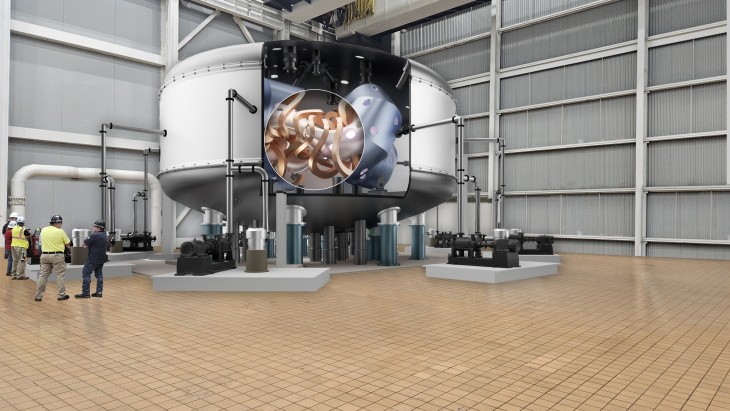
Type One Energy is working with the Tennessee Valley Authority (TVA) and Oak Ridge National Laboratory (ORNL) to develop a stellarator to verify Type One Energy's Fusion Power Plant (FPP) concept. The device is currently planned to be built at the TVA's Bull Run retired coal power plant.
The results of Infinity One will inform Type One Energy's Infinity Two project.
Infinity Two
Type One Energy
Type One Energy is working with the Tennessee Valley Authority (TVA) to develop a 350 MWe fusion power plant that is currently planned to begin operations by the mid 2030s.
As of early 2025, Type One Energy has partnered with Commonwealth Fusion Systems (CFS) whereby CFS has granted Type One Energy access to use their high-temperature superconducting (HTS) cable technology. This arrangement will help support Type One Energy's development of the Infinity Two's stellarator magnet system.
LHD
National Institute for Fusion Science + 1
1998 - Present
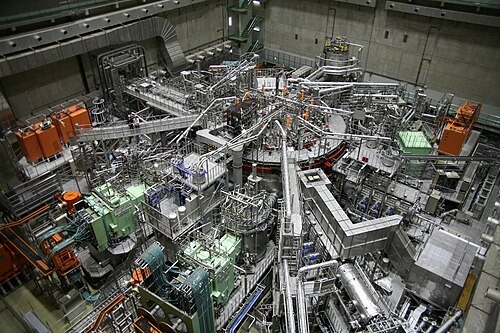
The Large Helical Device (LHD) is a superconducting helical stellarator (heliotron) operated by the National Institute for Fusion Science (NIFS) in Japan. Since beginning operation in 1998, LHD has pursued steady-state, high-temperature plasma confinement as a pathfinder for helical stellarator fusion approach. It has demonstrated plasmas with ion and electron temperatures reaching over 100 million degrees Celsius, establishing reactor-relevant high-temperature operation in a stellarator configuration. LHD was constructed on time and on budget through the efforts and capabilities of Japanese engineering companies, demonstrating Japan’s strength in large-scale, high-precision fusion engineering.
LHD has also set landmark records for long-pulse operation, sustaining high-temperature plasmas for more than 3,000 seconds (about one hour), thereby experimentally demonstrating steady-state capability with superconducting coils and continuous heating systems. In terms of overall performance, LHD has achieved fusion triple products exceeding 10¹⁹ keV·s/m³, in the same order of magnitude as the high-performance discharges reported on Germany’s Wendelstein 7-X stellarator, underscoring the competitiveness of the stellarator approach to magnetic confinement fusion.
Model A
Princeton Plasma Physics Laboratory
1953 - 1953
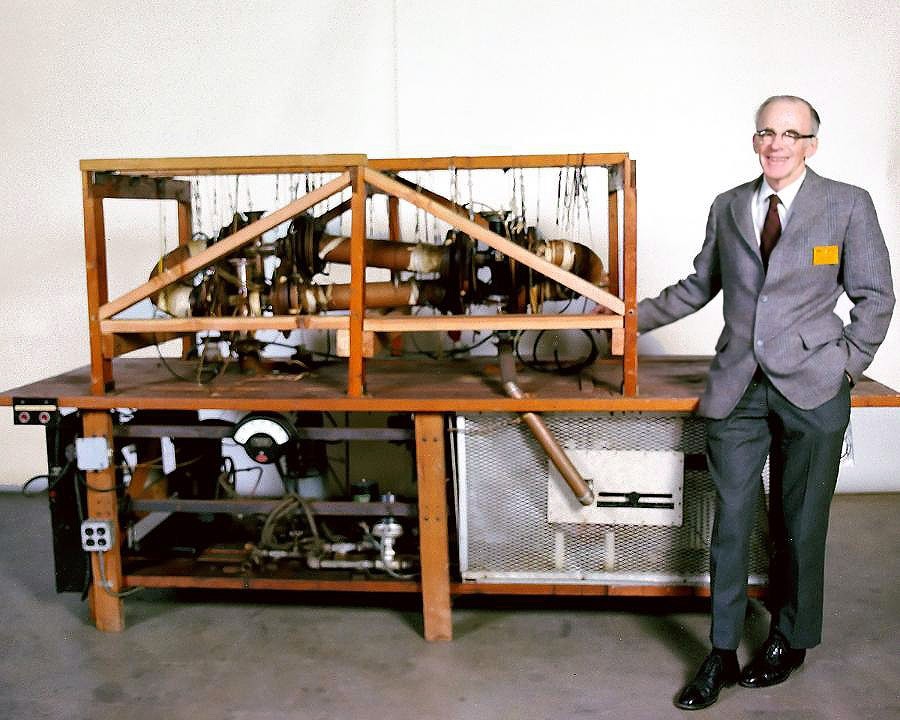
Model A was the world's first stellarator. It was a table-top device with a figure-8 shape made at the Project Matterhorn facilities (now known as Princeton Plasma Physics Laboratory or PPPL) at Princeton University. The vacuum chamber was made of 5 cm diameter circular cross section Pyrex glass tubes. The plasma was produced with inductively coupled radio frequency electric fields and confinement coils were energized by a DC generator.
Model A's main goal was to demonstrate that the magnetic confinement idea works. Once this was achieved, Model A went out of operation and research continued with the construction of Model B.
Model B-1
Princeton Plasma Physics Laboratory
1954 - 1959
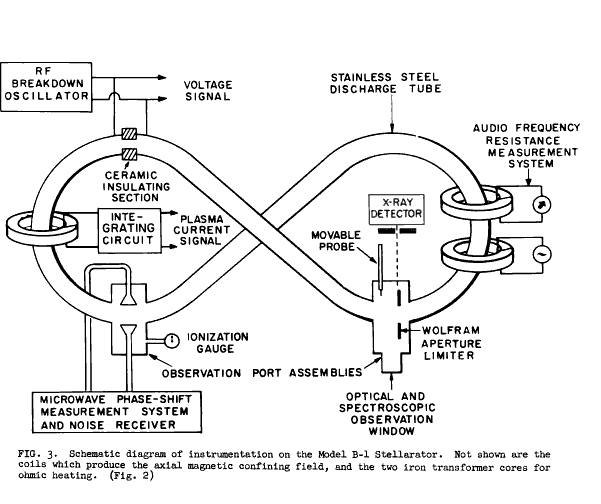
Model B-1 was the first version of a series of devices built at PPPL under the name "Model-B". Like Model A, this stellarator was made from 5 cm diameter Pyrex tubes in a figure-eight configuration but with a much stronger magnetic field (around 3T). It utilized ultra-high vacuum and the plasma reached 100 eV temperatures using ohmic heating. The magnetic confinement produced with this device was excellent for single particles but it failed to maintain a confined plasma for greater than 10 ms, mainly because of collective plasma behavior and transport.
Model B-2
Princeton Plasma Physics Laboratory
1956 - 1958
Model B-2 was a bigger version of Model B-1. It still used 5 cm cross-section diameter tubes but also included a 50 cm long section with an expanded diameter. It used ohmic heating, which produced similar results to the ones obtained in B-1, including short confinement times. Model B-2 was built to study the magnetic pumping process of heating. Although this process made it possible to reach higher temperatures, the presence of impurities and the short confinement times precluded the achievement of the expected temperature of 1 keV. This stellarator was exhibited at the United Nations' Second International Conference on the Peaceful Uses of Atomic Energy in Geneva, Switzerland.
Model B-3
Princeton Plasma Physics Laboratory
1958 - 1966
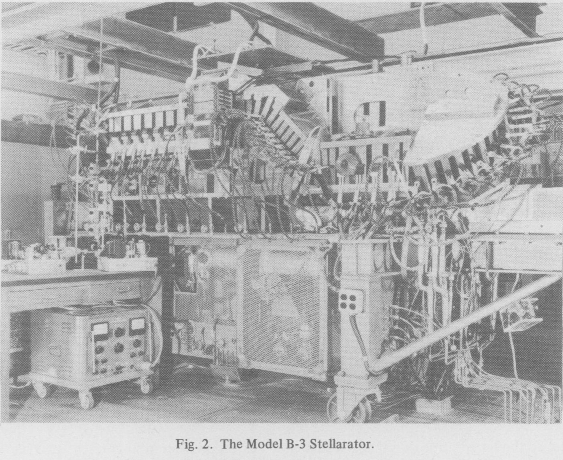
Model B-3 was the last device made with a figure-eight configuration in PPPL. As most of the Model Bs, it was made using 5cm diameter tubes. It was used to study confinement of ohmically heated plasmas and included helical windings, a divertor, and a gas purification system. The helical coils didn't improve the confinement and due to "pump-out", confinement time was only a few microseconds. These results confirmed that the actual confinement was lower than classical predictions and phenomena like pump-out needed further research.
The results of the Model B-3's ion-cyclotron heating and the general data gained about stellarator operating conditions led to the construction of Model B-66.
Model B-64
Princeton Plasma Physics Laboratory
1955 - 1967
Model B-64 was a figure-eight shaped stellarator operated at Princeton Project Matterhorn (today, PPPL). It was made using 10 cm diameter stainless steel tubes.
It had square corners which made it look like an squared 8, so it was originally named Model B-8<sup>20</sup>. However, since at that point the project was classified, the United States Atomic Energy Commission security office objected to the name claiming that the secret of the figure-eight shape was compromised and the 8<sup>2</sup> was substituted with a 64.
Model B-64 was the first device to use a divertor, which enabled ion temperatures of 50 eV and electron temperatures of 80 eV, improving on the 10 eV temperatures reached prior the installation of the divertor.
Model B-65
Princeton Plasma Physics Laboratory
1957 - 1967
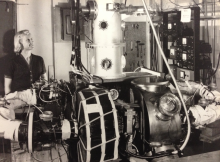
Model B-65 was a race-track shaped stellarator built at Princeton University. It was the first race-track device with helical windings to provide rotational transform and magnetic shear. It also included Model B64's divertor which improved the heating, which led to reported temperatures above 100 eV. Model B-65 was also used for the first high power ion-cyclotron heating experiments using deuterium.
Model B-66
Princeton Plasma Physics Laboratory
1959 - 1969
Model B-66 was the last of the B series stellarator devices. It had a racetrack shape but was used mainly as a magnetic mirror rather than as stellarator. It had a stronger magnetic field than its predecessors and an a ultra high vacuum system. B-66 was used to test the magnetic pumping at the ion cyclotron frequency and reached temperatures of about 200 eV.
Model C
Princeton Plasma Physics Laboratory
1962 - 1969
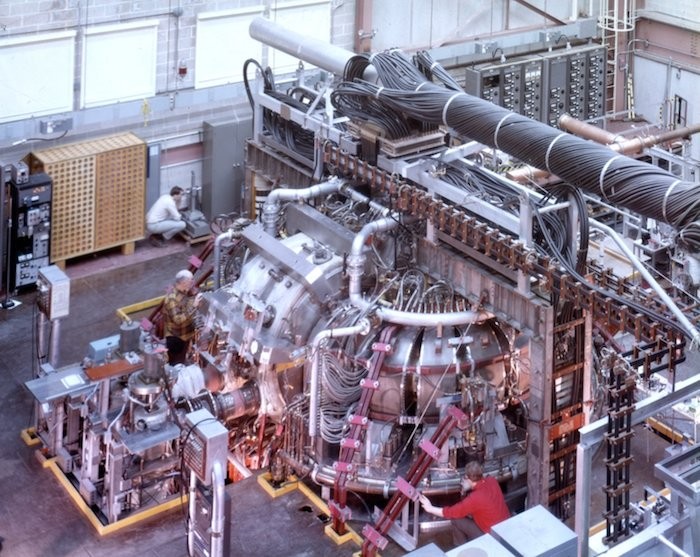
Model C was a stellarator built and operated at the Princeton Plasma Physics Laboratory (PPPL). The device's design and implementation planning began in 1954 and started operations in March 1962.
Model C was the biggest of a series of stellarators that marked the beginning of fusion research at Princeton. It had a racetrack-like geometry with two semicircular sections with helical windings connected with two straight segments, one that contained a divertor and the other contained 4 MW of ion cyclotron resonance heating. Even though Model C represented a major upgrade in comparison with models A and B, it did not achieve the expected temperature and confinement results for which it was designed.
Finally, in 1969, Model C stopped operations and was converted into a tokamak geometry, changing its name to Symmetric Tokamak (ST).

