
New industries rely mainly on technological advancement - at least, that's what most people believe. However it is often the individuals behind the technology that drive a nascent field's growth. This factor, which we can call 'human capital,' has shaped a range of industries. For example, the development of the semiconductor landscape was influenced greatly by 8 individuals who left Shockley to found Fairchild Semiconductor (the 'Traitorous 8').
Those involved in the private fusion industry likely understand the impact ARPA-E has had on its development in the United States. ARPA-E has invested $134M to-date in fusion, primarily through its ALPHA, BETHE, GAMOW, and CHADWICK programs. ARPA-E fusion performers have attracted $1.5B in follow-on funding on the private market, and the number of private companies in the market has grown from 12 to over 50 since ARPA-E began funding fusion.
However, what may be less well-known is the impact of the careers of ARPA-E project alumni on the private fusion industry. This summer, ARPA-E wanted to explore this idea of the agency's human capital impact to fusion, and I led this project as part of ARPA-E's Summer Scholars internship program (data collected during June-July 2026).
ARPA-E's ALPHA program built the initial fusion human capital network in the U.S.
The ALPHA program was ARPA-E's first foray into fusion, which invested an initial $30M into magneto-inertial fusion between 2015-2020. The program, initiated and led by Program Director Patrick McGrath, funded 14 total projects, including five national laboratories, six private companies, and three universities. 157 total individuals were meaningfully involved - these ALPHA alums have since gone on to work within dozens of private-sector, public, and academic organizations.
A majority of the 157 people fell into three groups: PIs, early-career scientists, and mid-to-late-career scientists (incl. professors). After the conclusion of their ALPHA projects, those later in their career were significantly more likely to end-up working for private fusion companies than early-career scientists (~30% ended up in the private fusion industry) [See - Exhibit 1]. PIs, though small in number, even more consistently stayed in private fusion (near 50%). We found that the post docs & PhDs involved in ALPHA more frequently ended up in national labs, universities, or non-fusion-focused companies (such as Google or Boeing). This isn't necessarily a bad thing - but those who were later in their career remained stickier in the private fusion industry after ALPHA.
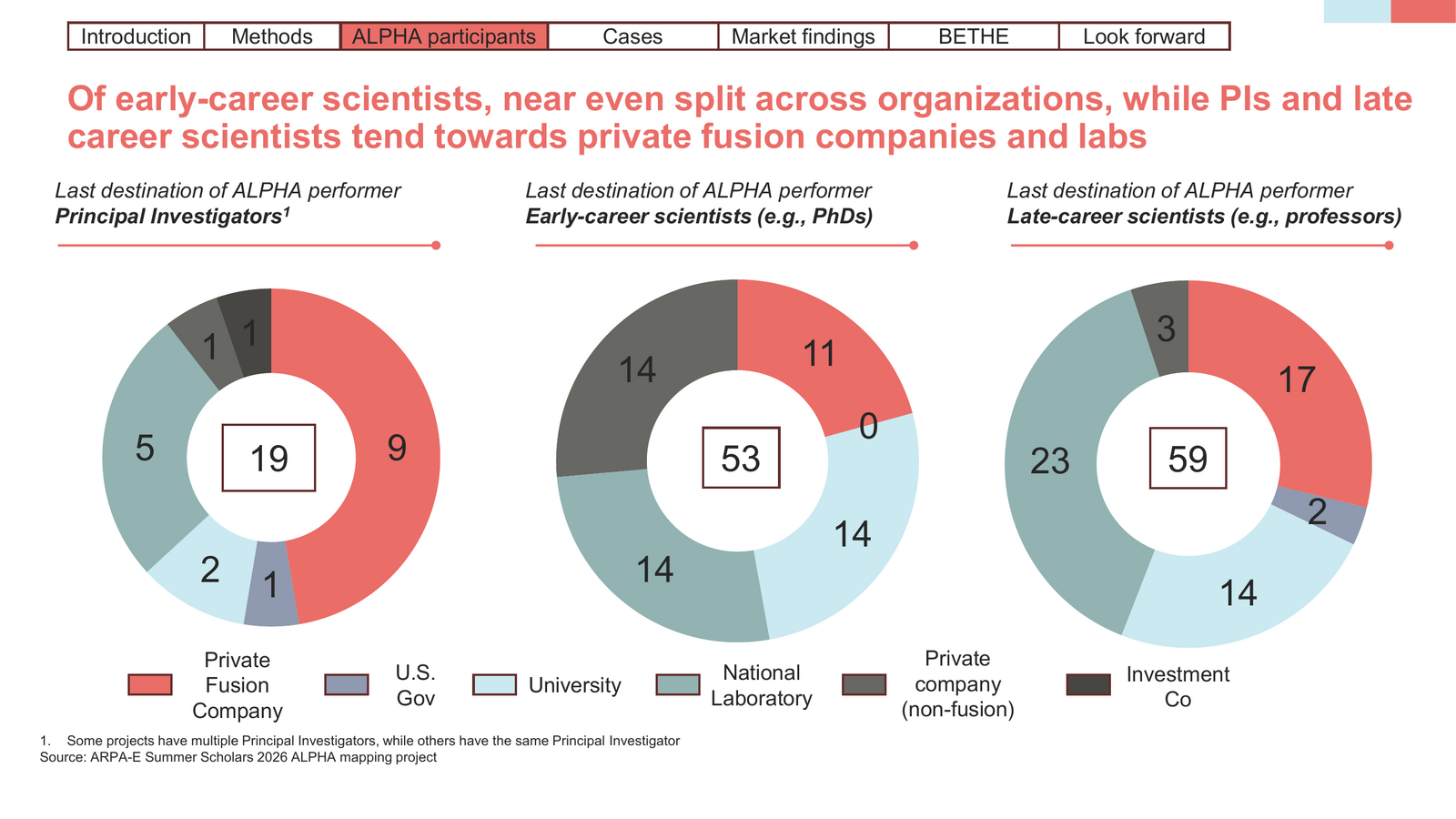
Exhibit 1
ALPHA alums joined companies representing over half of private fusion funding in the U.S.
The companies most impacted by ALPHA alumni were, of course, the companies funded directly by ALPHA (or spun out of ALPHA projects) - including Helion, HyperV/HyperJet, and MIFTI. Beyond this group, we found that 23 total fusion companies had at least one ALPHA alum as part of their workforce, including seven of the 12 highest-funded fusion companies [See - Exhibit 2]. Given ALPHA's focus on a specific technology vector (magneto-inertial fusion), this is tremendous; when including BETHE and other ARPA-E funding (e.g., GAMOW) alongside, ARPA-E has either funded or trained alums working in 11 of the 12 highest-funded fusion companies in the United States. ARPA-E's impact on the private fusion industry stretches beyond just technical talent within the organization; when looking at leadership teams of top companies, we found that a majority had ALPHA or BETHE performers as part of their C-suites.
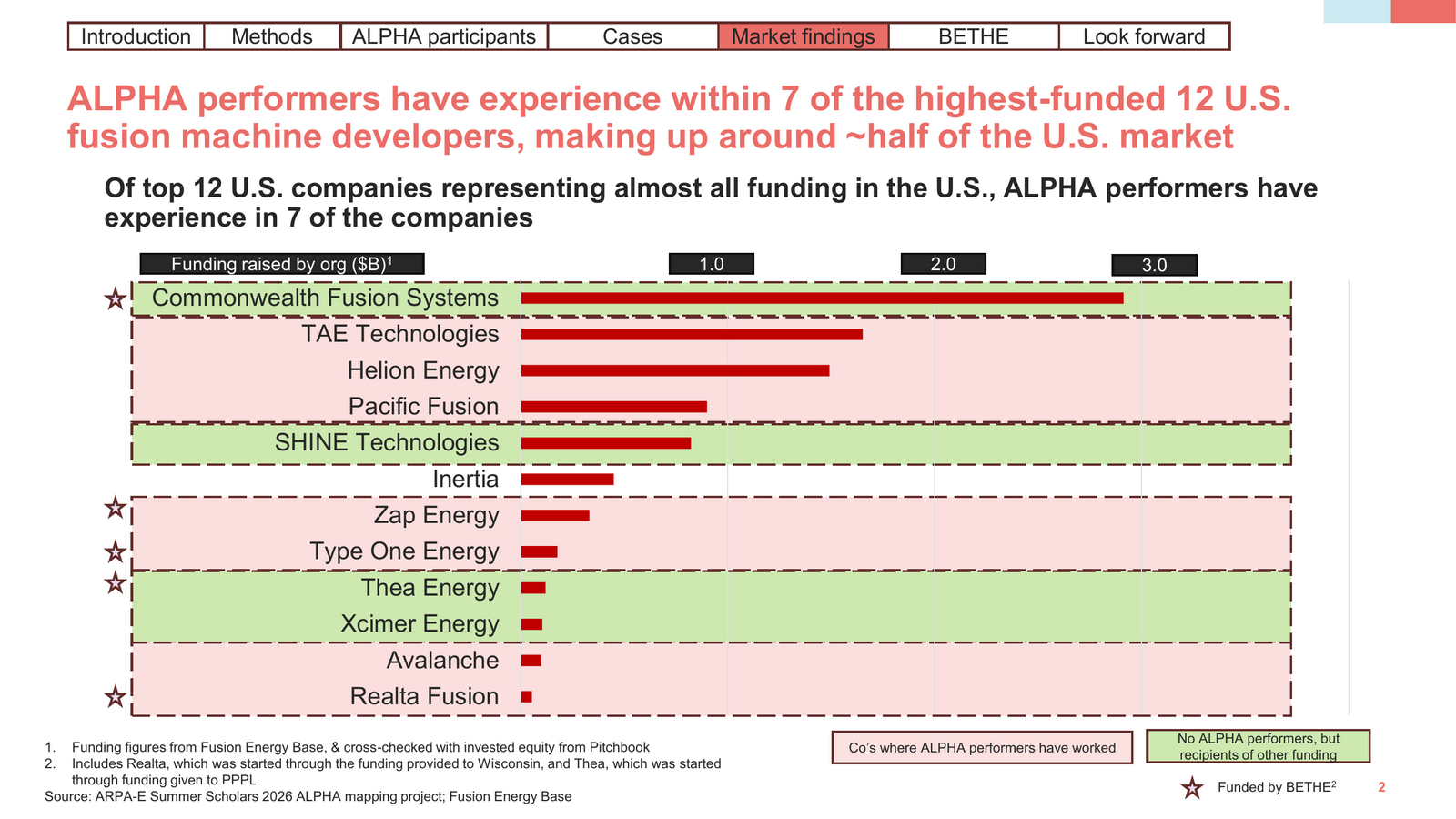
Exhibit 2
The stories of ALPHA's people are diverse, and many individuals have made multiple career moves after their project engagements with ARPA-E ended. We wanted to highlight a few illustrative examples of impactful careers that have stemmed from the ALPHA program.
Scott Hsu is well known in his role as Fusion Partner at Lowercarbon Capital, one of the most prolific VCs in the fusion space. However, in his years leading up to this role, he was Principal Investigator on Los Alamos National Laboratory's (LANL) Plasma Liner Experiment (PLX) project supported by the ARPA-E ALPHA program. He went on to join ARPA-E directly as a Program Director - where he developed the BETHE and GAMOW programs - and then moved to the DOE Office of the Under Secretary for Science and Innovation as DOE Lead Fusion Coordinator - where he focused on accelerating fusion commercialization. After a successful journey at the DOE he moved to the private sector at Lowercarbon Capital in 2025.
Multiple members of the LANL ALPHA team continued through to the origins of the company Near Star Fusion. Ed Cruz, who is one example, worked with HyperJet/HyperV, remained on the project through its BETHE extension, and helped develop Near Star. He then went on to support ARPA-E directly through Booz Allen, and most recently moved to being a Program Director himself.
Brian Nelson and Uri Shumlak were professors at University of Washington (UW) and leaders of the UW project. Supported by the ALPHA program, Brian and Uri went on to be founding members of Zap Energy, which itself was a recipient of follow-on BETHE funding. Derek Sutherland - who received his PhD from UW - was co-founder & CEO of CTFusion, then a team member with Zap Energy, and is now the Chief Scientific Officer at Realta Fusion.
Others stay tightly aligned with the companies that they worked for when they received ALPHA funding. David Kirtley, founder & CEO of Helion, was part of the ALPHA team - he has stayed with the organization. Similarly Michael Brown (Swarthmore College) and Daniel Sinars (Sandia National Labs) were PIs of their projects and have remained with their organizations.
In addition to ALPHA performers, former ARPA-E employees contributed to the development of the fusion energy space. Will Regan was an ARPA-E Fellow, who then went on to co-found Pacific Fusion. Ryan Umstattd was a T2M Advisor at ARPA-E, who then went on to manage product and partnerships as a VP at Zap.
While we only highlighted a handful of stories here, there were many other incredible journeys that stemmed from working on ALPHA and have impacted dozens of organizations [Exhibit 3]. Through this all, a remarkably high number have remained in the U.S. - over 95% of funded individuals stayed with organizations in-country.
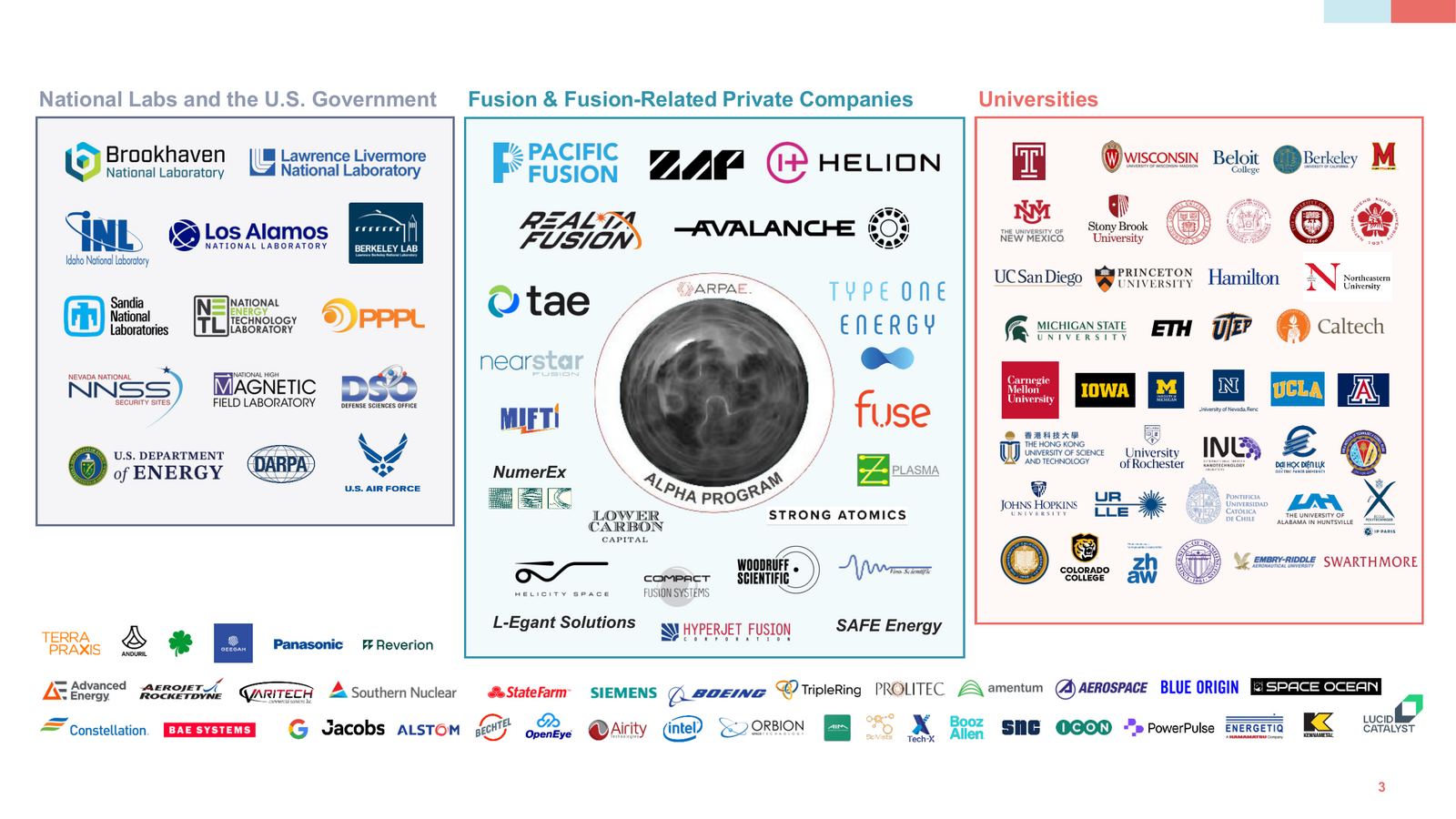
Exhibit 3
"If it works, will it matter" - a continued case for ARPA-E funding in fusion
Within ARPA-E, there is an often repeated catch-phrase: "if it works, will it matter." Though this can apply to the technologies ARPA-E helps develop, the saying also includes the impact of ARPA-E alumni. The Agency's impacts to fusion are actually understated in this study, given the wide array of projects in the other fusion programs: BETHE, GAMOW, and OPEN. Going forward, it would be amazing to see more research on human capital stemming from those programs - and in many years, the impact of the upcoming $135M fusion program currently in the works. ARPA-E's funding for fusion-focused companies and labs has strengthened the talent landscape in the U.S. - doubling-down on this industry will drive American excellence in fusion moving forward.
Brendan Massoud is a second-year MBA student at Wharton and was a 2026 Technology-to-Market Summer Scholar with ARPA-E, focused on fusion energy. Prior to this, Brendan worked at Boston Consulting Group as a member of its energy and climate & sustainability practices. He is passionate about the commercialization of advanced energy solutions and currently resides in Philadelphia.

