
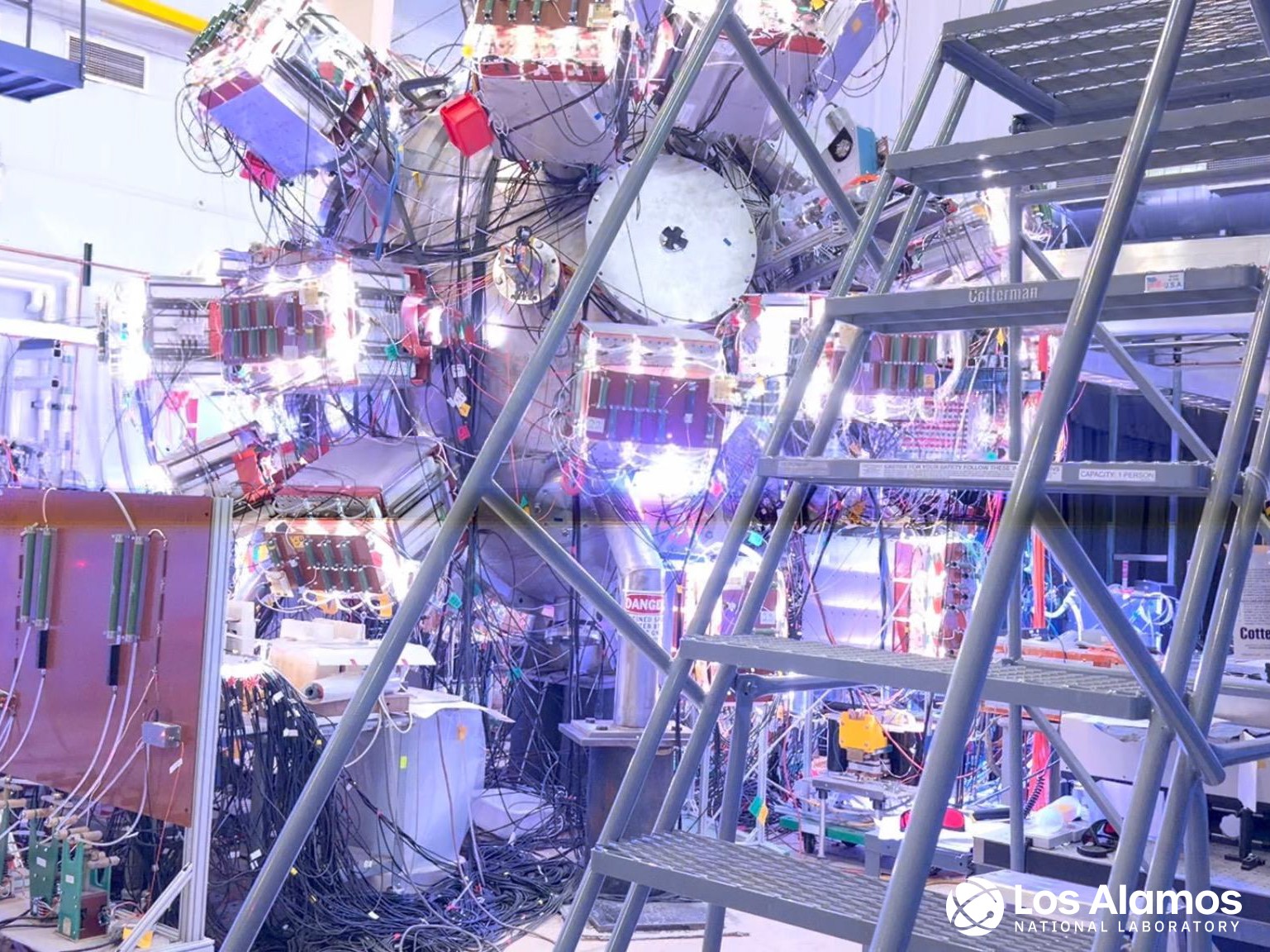
The Plasma Liner Experiment at Los Alamos National Laboratory. Thirty-six plasma guns are mounted on the spherical vacuum chamber, with capacitor banks and switches attached directly to each gun. Photo: Los Alamos National Laboratory.
We interviewed Koichi Masuda, founder and CEO of Liberty Fusion, about commercializing plasma-jet-driven magneto-inertial fusion (PJMIF) and building a fusion plant where the economics come first.
Liberty Fusion is a Santa Fe-based fusion developer founded in 2025 to commercialize PJMIF, a concept developed at Los Alamos National Laboratory through the Plasma Liner Experiment (PLX). The company inherited the PLX hardware under a licensing agreement with the laboratory and is now developing its own plasma guns at the New Mexico Innovation Hub. Masuda trained in nuclear engineering and energy security policy before commercialization roles at SunEdison, Podium, Google, and EX-Fusion.
1. For someone who hasn't come across PJMIF, how would you describe what Liberty Fusion is building, and what makes it different from the tokamaks and laser facilities people usually picture?
Liberty Fusion is building a modular, carbon-free, base-load power plant based on the PJMIF concept.
Where tokamaks rely on massive superconducting magnets and laser facilities on complex optics and fragile targets, we use an array of coaxial plasma guns for everything. A subset of the guns inject magnetized fuel plasma into the center of the chamber; the rest fire plasma jets that merge into a spherical liner and compress that fuel until it fuses. That puts us in a regime between magnetic and inertial confinement, and both steps, forming the liner and forming a magnetized target, have been demonstrated experimentally on PLX at Los Alamos, though the target is not yet optimized.
The approach is cost-effective by design. The guns sit meters back from the reaction, so they do not see the heat and neutron fluxes that plasma-facing components take in other approaches, and they are mass-producible consumables replaced on a regular cycle rather than engineered to survive the life of the plant. For fusion to matter as an energy source, the economics have to make sense before the scientific breakthrough, not after it.
2. What led you to found Liberty Fusion in 2025, and what made PJMIF ready to move from a Los Alamos program into a company?
I founded Liberty Fusion in 2025 to bridge the gap between experimental fusion research and industrial energy production. The PJMIF concept was developed at Los Alamos National Laboratory through PLX and ARPA-E-funded programs, both ALPHA and BETHE, and it had reached the point where the core physics was validated. What remained was advancing plasma gun design and engineering, developing the supply chain, and integrating the full system. Those are commercial problems, and a company with the agility to iterate quickly is far better suited to them than a national laboratory program.
We worked alongside the Department of Energy, ARPA-E, and the Los Alamos tech-to-market transfer team, supported by the Feynman Center for Innovation, to ensure a smooth transition of the intellectual property, the resources, and the institutional knowledge around PLX and PJMIF to Liberty Fusion. We were also fortunate that our licensing agreement allowed us to inherit the physical hardware from the PLX experiment, much of it already proven over thousands of shots validating the core PJMIF concept.
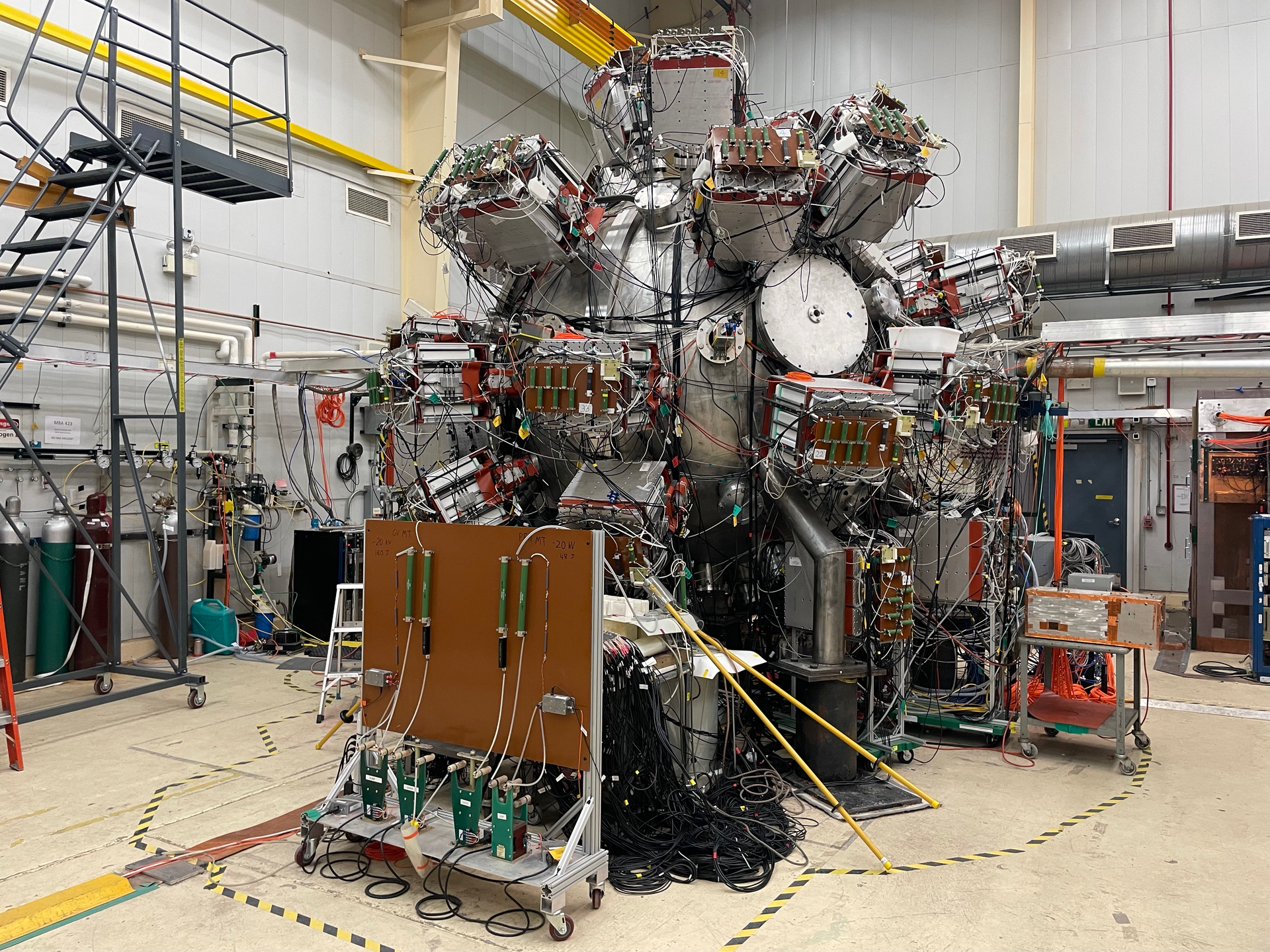
PLX in its former lab at Los Alamos. Liberty Fusion inherited the chamber, the guns, and the pulsed-power hardware under its licensing agreement with the laboratory. Photo: Los Alamos National Laboratory.
3. Your path runs from nuclear engineering at Wisconsin, through energy security policy at George Washington, to commercialization roles at SunEdison, Podium, Google Japan, and EX-Fusion. How does that mix shape the way you're building Liberty Fusion?
Studying nuclear engineering at Wisconsin, then pursuing my master's at George Washington, and then working at SunEdison, Podium, Google, and EX-Fusion gave me a holistic view of what a deep-tech startup actually needs to succeed.
The full-stack perspective I refer to comes down to this: a startup has to think about cost competitiveness and customer acquisition from the beginning, not after the science is finished. For any energy developer, the most important parameter is the levelized cost of electricity (LCOE), and the techno-economic analysis that substantiates that number. Alongside that sit supply chain resilience and the robustness of the ecosystem being built around fusion. Ultimately, what we are building is a policy-aligned, economically competitive system that serves U.S. energy policy and can be exported beyond our borders.
My own path reinforced this. At SunEdison I worked on power purchase agreement (PPA) models. At Podium I helped scale a small company into a multibillion-dollar business. At Google I helped build an entire team halfway around the world while holding the same technical rigor. That led me to join EX-Fusion in Japan as a founding member, working to advance laser fusion there. After the NIF results in 2022, I expected a scientific breakthrough of that magnitude to galvanize public enthusiasm and investment in fusion. The reality was far less rosy. The lesson I took from it is that cost matters more to the market than any single scientific milestone. So from day one, I set out to build a company that is technically sound, economically competitive, and aligned with both national and state-level energy policy.
4. Your design keeps the plasma guns meters back from the fusion event rather than up against it. Why does that standoff distance matter so much for the economics and for running a plant shot after shot?
Keeping the plasma guns away from the fusion reaction, rather than adjacent to it, is what makes PJMIF commercially viable. Our fusion drivers, the plasma guns arrayed around the perimeter of the chamber, are less expensive than the drivers and plasma-facing components in other approaches, and physically distant from the fusion reactions, and our preliminary neutronics work indicates that even at 1 Hz operation they should continue to meet their performance requirements for roughly two years.
That standoff distance reduces maintenance costs, minimizes downtime, and allows the system to fire rapidly and reproducibly, shot to shot and gun to gun. Having a large number of guns also gives us redundancy: if one or two fail, whether from mechanical wear or the ordinary statistics of machines failing, the system can compensate and keep the plant running until a scheduled maintenance window.
5. Where does the technology stand today experimentally, and what do simulations predict as you extrapolate toward fusion-relevant regimes?
Experimentally, the PLX program validated the core physics of forming a plasma liner and forming a magnetized target, which were its fundamental required outputs. Those experiments demonstrated that a magnetized target can be created with plasma guns, though not yet optimized, and that a reasonably structured plasma liner can be formed with the guns available to us.
Compression and heating of that target as the liner converges on it has been shown in simulation, and we are now running simulations of a full fusion gain pulse. Using codes such as SPFMax and FLASH alongside our university partners, we are modeling a full-scale system targeting a gain of roughly 10 to 12. We have credible simulation results from those partners showing an economically viable pathway for PJMIF to reach commercial gain and commercial power production, and our extrapolations are built on validated codes.
Looking ahead, there is still substantial work to do in producing a better liner and a more complete magnetized fuel target with these guns. But the core principles of how a PJMIF system is supposed to work are validated.
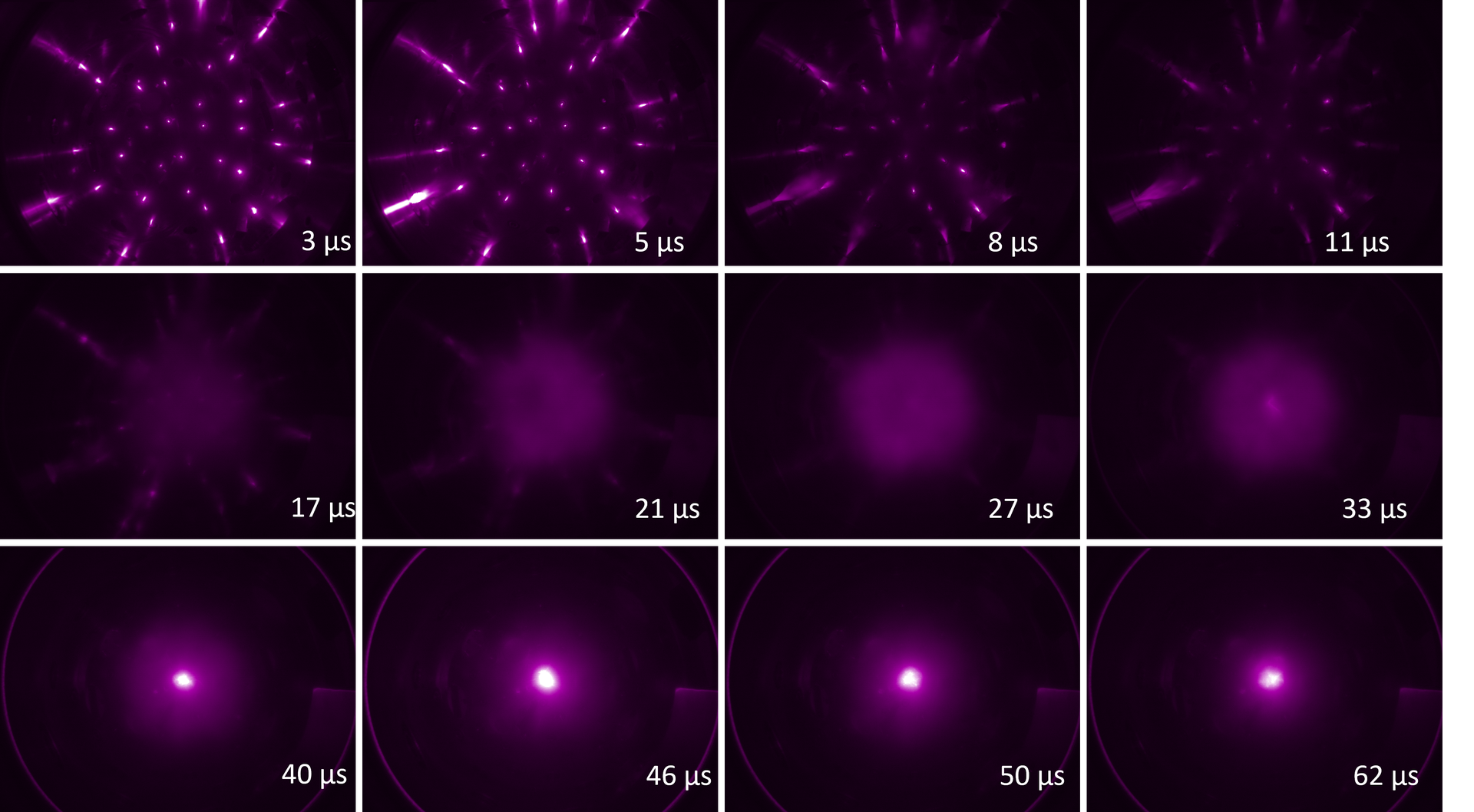
Thirty-six argon plasma jets merging into a spherical liner on PLX, imaged from inside the chamber over roughly 60 microseconds. Each frame is from a separate shot. Figure from LaJoie et al., Physics of Plasmas 31, 102701 (2024).
6. What does the path from today's experiments to a working power plant look like for Liberty Fusion?
Our path to a fusion plant runs on two parallel tracks, developing fusion-relevant plasma guns and experimenting with magnetized target formation, followed by full-system integration.
On the guns, the critical benchmark is mass. Today each gun delivers 1 to 2 milligrams per shot; a breakeven-class liner requires 15 to 20 milligrams per gun. Velocity and timing, by contrast, are already within a parameter space we consider acceptable. We are currently building the first official Liberty Fusion Gun (LFG), a single design reflecting the latest scientific and technical benchmarks. That gun becomes the foundation we build our next generations on.
On the target, some would suggest a compact toroid or FRC-like target formation. We prefer to hold to a core principle, simplicity wins, and to form the magnetized target using our own plasma guns. We will run experiments on target formation and magnetized target design on the PLX vacuum vessel at our facility at the New Mexico Innovation Hub over the next couple of years, as part of the Project Torch effort.
Integration comes after both tracks. Plant-level design selections such as first wall material and the tritium breeding blanket come at that stage.
7. You've set a target of electricity below $50 per megawatt-hour. What gives you confidence that Liberty Fusion can reach that cost point?
The confidence comes from the fundamentals of the PJMIF design itself.
Our preliminary neutronics puts the plasma guns on a roughly two-year replacement cycle, the vacuum vessel on a roughly six-year cycle, and the plant itself on a 30-to-40-year life. That makes the guns the dominant recurring cost, so that is where the analysis starts.
Both the liner guns and the target guns will likely be replaced on that two-year cycle. Each unit costs roughly $100,000 to $150,000 initially, with the potential to refurbish for under $50,000 per unit. For a 250 MW facility, we anticipate a design consuming approximately 300 plasma guns, roughly 90% dedicated to liner formation and 10% to target formation.
Put those numbers together and the picture is straightforward. At an 85% capacity factor, a 250 MW plant delivers roughly 1.86 million megawatt-hours a year. Refurbishing 300 guns at under $50,000 each on a two-year cycle costs about $7.5 million a year, approximately $4 per megawatt-hour, or under 10% of our target price point. Even in the worst case, where every gun is replaced with a new unit at $100,000 to $150,000 rather than refurbished, the figure lands between $8 and $12 per megawatt-hour. Our single largest consumable stays well inside the envelope either way.
Replacement also does not cost us much output. We anticipate downtime of under two months on a two-year cycle, and at the plant level we build in units of 250 MW. A gigawatt site is built from multiple 250 MW units with staggered maintenance schedules, so gun replacement never takes the whole plant offline.
8. As you move from simulations and gun prototyping toward larger integrated systems, what will you need from the fusion supply chain?
As we move from simulation and gun prototyping toward a larger integrated system, the critical supply chain areas are capacitors, high-speed switches, and gas valves. We need to see both innovation and increased supply in those categories from fusion supply chain companies.
Our hope is to co-develop some of these technologies with partners in New Mexico and abroad, particularly in pulsed power and solid-state switching, work that would be useful to other fusion companies as well.
One philosophy we hold firmly is that our raw material supply must not be constrained by export or import restrictions. In designing the plasma guns, we deliberately avoid critical minerals wherever possible and, where they are unavoidable, use them in the smallest quantities we can. Those choices are made with global deployment in mind: PJMIF should rest on a supply chain that is not dependent on any single company or country.
9. Liberty Fusion frames its mission around a distinctly American identity, from the Declaration of Energy Independence to the Fusionist Papers. What's the long-term vision you want that framing to convey?
The vision behind that framing is energy sovereignty and economic renewal. From the Declaration of Energy Independence to the Fusionist Papers, the message is that the United States should not merely consume energy technology. It should develop and manufacture this new clean power paradigm.
Fusion is an industrial achievement, not only a scientific one, and we intend to anchor durable manufacturing jobs and secure infrastructure here in the United States.
But the vision extends beyond our borders. We want this technology democratized equitably, serving not only the United States and its allies but the global community, so that all of humanity has access to abundant energy. Done right, that reshapes global politics and economic growth, and humanity enters a new phase of growth and civilization.
To learn more about Liberty Fusion, visit libertyfusion.com.

