

We interviewed Ian Ochs, co-founder and CTO of Borealis Fusion, about the case for proton-boron-11 (pB11) fuel and the tandem mirror machine the company is designing around it.
Borealis Fusion is a New York-based fusion developer founded in 2026 to build a power plant around pB11 fuel. Its machine concept, PRISM (pB11 Rotating Ion Separation Mirror), is derived from the tandem mirror, and a $6 million seed round supports an integrated physics assessment and a costed design for a first experimental campaign. Ochs is one of four co-founders who worked on pB11 research at Princeton. The fifth, CEO Damien Scott, led the 1¢/kWh Fusion Energy initiative at the Astera Institute.
1. What is Borealis Fusion building, and who is behind it?
Borealis Fusion is developing a fusion power plant designed from the fuel outward. Our mission is to make fusion the lowest-cost source of firm electricity. We chose proton-boron-11 (pB11) because its stable, nonradioactive fuel, lack of a tritium fuel cycle, and much lower neutron output could make the power plant simpler and cheaper. The machine concept we are developing is PRISM (pB11 Rotating Ion Separation Mirror): a confinement architecture derived from the tandem mirror and adapted to the fuel's requirements.
Five of us founded the company in 2026. Four of us, Elijah Kolmes, Alex Glasser, Tal Rubin and I, worked at Princeton on pB11 research supported by ARPA-E and DOE Fusion Energy Sciences. Our backgrounds span analytic theory, computational modeling and engineering. Damien Scott, our CEO, founded the software company Marain, acquired by General Motors in 2022, spent seven years in Formula 1, and conceived and led the 1¢/kWh Fusion Energy initiative at the Astera Institute, with Tal as physics lead.
We have raised a $6 million seed round from funds, foundations and individuals including Astera, Cambrian, CRV, Breakthrough Energy Fellows, Exponential Capital, Freestyle Capital and BY Venture Partners.
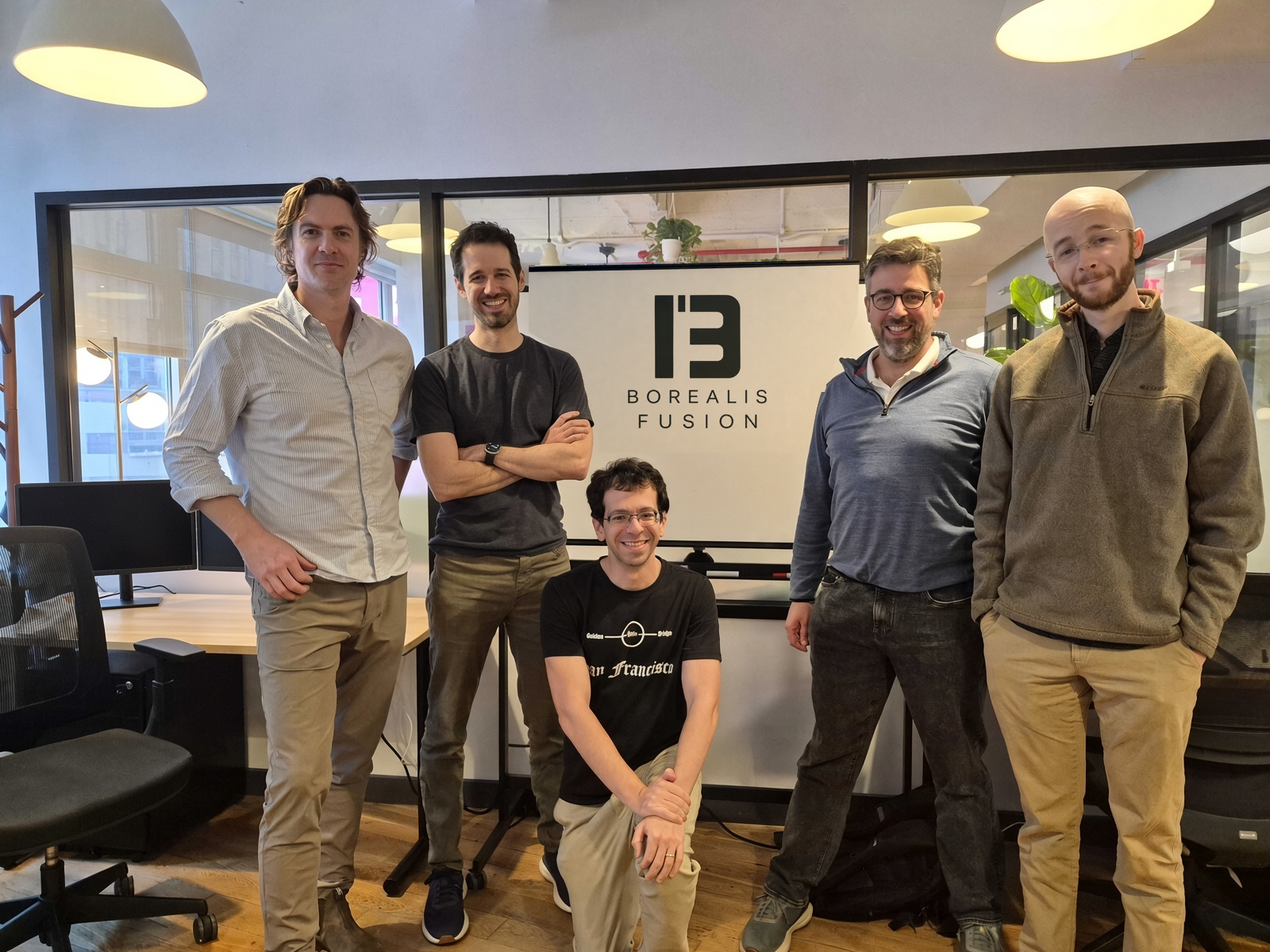 The Borealis Fusion co-founders in New York, October 2026. Photo: Borealis Fusion.
2. How did the five of you come together, and what turned a Princeton research group into a company in 2026?
Four of us overlapped at Princeton working on the theory of pB11 plasmas. We were trying to understand which losses are fixed by physics, which can be reduced, and what that means for a practical machine. Our work on radiation handling, power balance, and helium ash extraction made tandem mirrors attractive because of the way their open ends allow us to control particle exhaust.
At Astera, Damien and Tal were studying what fusion would need to look like to deliver very cheap electricity. Their analysis examined whether the plant savings from cheap fuel and reduced neutron production could outweigh the harder plasma physics. That brought us to the same problem from different directions.
By 2026, we had enough theoretical work to begin designing a machine and a clear commercial objective to judge it against. We wanted a team focused on the full program: integrated modeling, experiments, engineering and the capital to build. Between us, we had the scientific background and experience building companies and running complex projects necessary to start that work.
3. What are the advantages and disadvantages of pB11 as a fusion fuel compared with D-T, and how is Borealis addressing the challenges?
D-T is the easier plasma; pB11 offers the prospect of a simpler power plant. Our thesis is that greatly reducing the tritium- and neutron-driven requirements on the plant is worth the more demanding plasma conditions.
D-T releases about 80% of its energy as 14 MeV neutrons. That creates requirements for shielding, radiation-resistant materials, component replacement and remote maintenance, alongside a blanket to breed the tritium the plant consumes. The primary pB11 reaction produces three helium nuclei and no neutrons. Side reactions produce some neutrons, but far fewer (< 1%) and at lower energy (~ 20%) compared with D-T, even before additional mitigations. The fuel cycle needs no tritium breeding or large-scale helium-3 supply. Hydrogen can come from water, and boron-11 makes up about 80% of natural boron. Both fuels are stable and nonradioactive.
The plasma conditions are the price. pB11 requires ion temperatures roughly twenty times higher than D-T and releases about half the energy per reaction. Electrons radiate X-rays as they scatter off boron nuclei. These bremsstrahlung losses leave a narrow margin for net power. In a 2025 paper, we showed that, in the regimes we examined, helium ash accumulation increases those losses enough that better confinement alone cannot deliver breakeven. The ash has to be kept out of the burning plasma while the fuel is retained.
Wave diffusion can help with the power balance: waves extract fusion-produced helium ions from the plasma while transferring their energy to the fuel ions, reducing radiation losses while boosting fuel reactivity. Our published calculations show how this enables breakeven at achievable confinement conditions. A mirror’s high plasma pressure relative to magnetic field, or “high beta,” also helps limit synchrotron radiation losses. The resulting plant still has demanding heat-handling and materials problems, and the equipment needed to achieve the plasma performance must not cost more than the plant advantages are worth.
4. What is a tandem mirror, what is different about yours, and what gives you confidence you can reach the conditions a pB11 power plant requires?
A magnetic mirror has a simple geometry: a straight solenoid with stronger magnetic fields at each end that reflect many charged particles back toward the middle. Particles moving fast enough along the field can escape. A tandem mirror adds plasma cells at the ends that create electrostatic potentials to help retain the ions. Advances in shear stabilization techniques and high-temperature superconducting magnets have renewed interest in mirrors by making the stronger fields and stable plasmas necessary for a fusion machine practical.
For pB11, the open ends offer ways to control exhaust according to particle species and energy. That is useful when helium ash needs to leave the burning plasma while fuel is retained. We also expect the linear layout, with repeated coils and wall panels, to offer component, construction, and maintenance cost advantages.
PRISM was conceived for pB11 from the outset. Rotating plasma physics is an important part of the team's background: my thesis was on wave-driven rotation in magnetized plasmas, Eli's on particle and energy rearrangement in rotating plasmas, and Tal and Alex have worked on stability and transport. Our published work informs the design; we are keeping the detailed implementation private.
The confidence comes from having a published theoretical basis for the effects we want to use. The integration remains unproven at power-plant conditions. Helium ash management, radiation losses, fuel confinement and heating all have to work together, with enough net electricity left to sell at a competitive price. That is what our modeling and experimental program is designed to test.
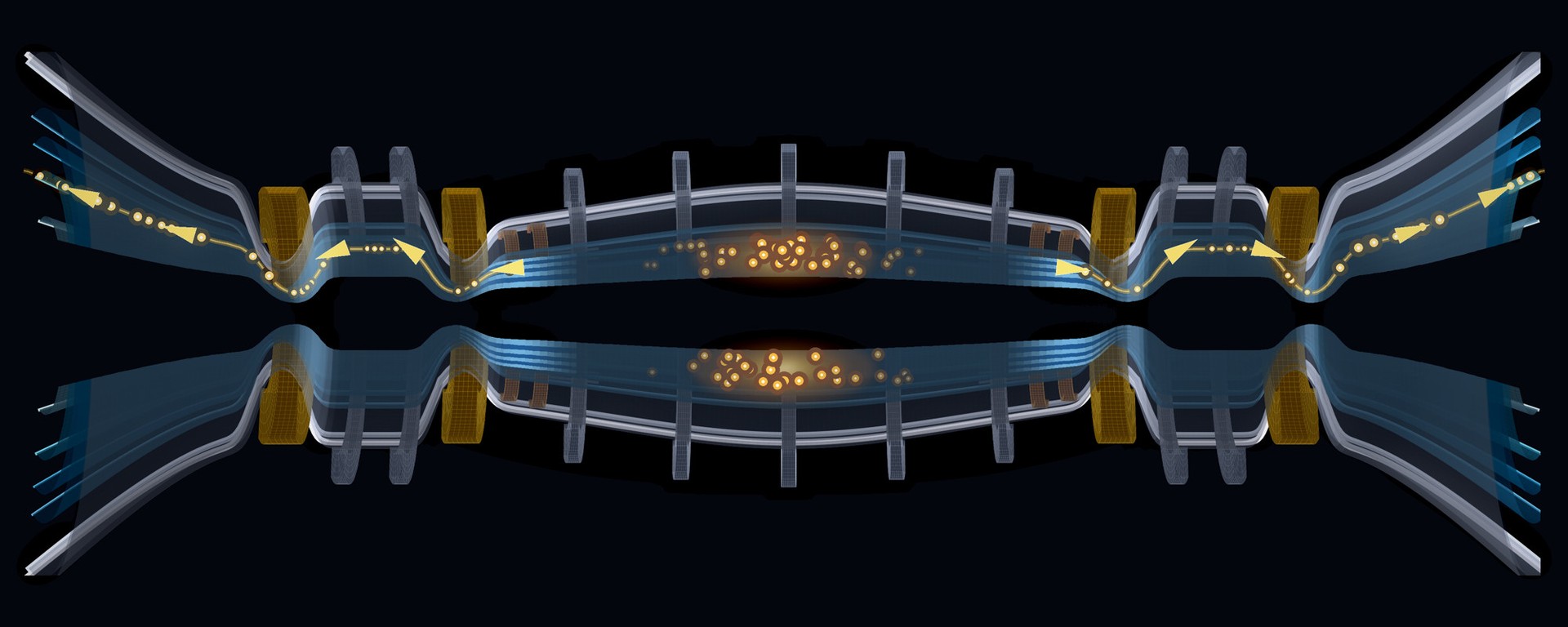 Conceptual rendering of PRISM (pB11 Rotating Ion Separation Mirror), Borealis Fusion's machine concept derived from the tandem mirror. Image: Borealis Fusion.
5. Borealis says the cost of the electricity it produces is "the objective against which we evaluate every design decision." What does that mean in numbers, and what drives the cost down?
We use five cents, two and a half cents and one cent per kilowatt-hour as design benchmarks. They give us increasingly demanding tests of how widely a future plant could compete. One cent is a long-term stretch goal.
The fuel choice removes the need for tritium breeding and reduces shielding, neutron damage and replacement costs. Those savings matter only if we can achieve the required plasma performance without adding more cost elsewhere. Higher plasma pressure and stronger magnetic fields can reduce the size of the fusion core, but the cost and power requirements of achieving them matter too.
Damien and Tal's public minimal-neutron study for Astera explored this tradeoff in an illustrative pB11 tandem mirror. It prices a plant under stated physics and engineering assumptions; its one-cent case is speculative. We use the work to understand which assumptions matter most.
We evaluate performance alongside equipment cost, power consumption, maintenance, construction time, availability and financing. The aim is the lowest lifetime cost of dependable electricity. We expect our estimates to become firmer as the design and evidence improve.
6. What has already been established for this approach experimentally, theoretically and in modeling, and what is left to do?
Our strongest evidence is theoretical. Before Borealis, members of the team published work on helium ash, radiation losses, helium extraction, mirror confinement and energy conversion in journals including Physical Review Letters, Nature Communications, Physics of Plasmas, Physical Review E, and the Journal of Plasma Physics. These papers establish constraints and possible ways to address them within the regimes studied. They provide the basis for our design work.
The experimental foundation comes from two places. First, it comes from the wider magnetic mirror community. Mirror experiments have demonstrated high plasma pressure relative to magnetic field, and machines using high-temperature superconducting magnets are operating. Rotating plasmas have also been studied experimentally for decades. Those are relevant precedents; they have not demonstrated our proposed pB11 operating regime. Borealis has no experimental hardware yet.
Second, experimental evidence comes from the broader fusion community, which has spent decades validating the core mathematical and computational models, such as wave modeling and Fokker-Planck modeling of fusion plasmas, that underlie our increasingly powerful suite of in-house simulation tools. Our published theory and current calculations identify a candidate operating point. The work now is to use this more advanced computational capability to test it in a self-consistent kinetic model that treats particle distributions, heating, radiation, confinement and ash management together. That means checking whether a gain in one part of the calculation creates a loss somewhere else.
The subsequent experimental campaign will test the key predictions. Beyond that, we need to engineer the plant, including a first wall that handles predominantly microwave and X-ray heating with much lower neutron loading than D-T, and establish that it can deliver dependable electricity at a competitive cost.
7. What milestones is Borealis setting for itself and its investors, and where does the experimental work start?
The next milestones are an integrated assessment of the physics and a costed design for the first experimental campaign. The seed funding supports both. The model needs to account for the power required to heat and confine the plasma and manage its exhaust, alongside the fusion power produced.
Experimental design is already part of the work. We are hiring the physicist who will lead it alongside the modeling program. The campaign needs measurements that can confirm or reject important predictions, with uncertainties specified in advance.
The deliverables include experimental requirements, the platform design, equipment and vendor costs, and facility requirements. Together, they define what the first hardware should test and what it will take to build it. The campaign's site, timing and scale will follow from that work.
8. Who is Borealis hiring, and what kind of person does well on a problem this hard?
Our key current opening is Senior Experimental Physicist. The person will own the design of our first experimental campaign, with the opportunity to recruit a team and build and lead the experimental program.
The first year is requirements, diagnostics, design, costing, vendor work and site selection. There is no experimental hardware to run yet. The role can be hybrid in New York or remote during design, with travel to vendors and candidate sites, then primarily on site as construction begins. We want someone who has built and commissioned plasma hardware, can make sound diagnostic choices, and can read our papers and argue with the assumptions. Judgment about what an experiment can actually establish matters as much as familiarity with the theory.
As we grow, we will need plasma theorists, computational physicists, experimentalists and engineers in magnets, vacuum, RF and diagnostics. We also want systems and operations people who have helped turn complex technical programs into working facilities. We welcome interest in future roles and from students seeking internships.
We want people who are exceptionally smart, relish extremely hard problems and are driven by the prospect of making cheap, dependable electricity available to more people. They learn quickly, test their assumptions against data and change their minds when the evidence calls for it. They move quickly from a question to a calculation or experiment that can answer it. The next people to join will help choose the experiments, design the facility and establish how the company builds.
Apply through borealisfusion.com/join.
9. What does the world look like if Borealis succeeds?
Cheaper, dependable electricity would make many goods and services more affordable. It could expand access to desalinated water, lower industrial costs and make carbon removal and synthetic fuels more viable. It would also support the growing electricity needs of computing, AI and robotics. The benefit is both in what becomes possible and in how many people can afford it.
We also want fusion to be deployable widely. Stable, nonradioactive fuels, no tritium fuel cycle and much lower neutron production could reduce some of the supply-chain, maintenance and proliferation challenges. Those properties could also ease licensing, safeguards and export-compliance burdens, although the requirements will depend on the plant and where it is deployed.
We chose pB11 because we believe its potential plant advantages justify the difficult physics. Success would mean more people could afford clean water, industrial goods and the energy to improve their lives.
To learn more about Borealis Fusion, visit borealisfusion.com.

